Heat Pump Compressor Trouble
Signs, Causes, and Next Steps
Compressor trouble can leave a Frederick County house with weak heating, weak cooling, new noises from the outdoor unit, or no comfort at all. The catch is that none of those symptoms proves the compressor failed. A bad capacitor, restricted airflow, a thermostat problem, low refrigerant, or a defrost issue can all wear the same costume.
The compressor circulates refrigerant so the system can move heat, and because a heat pump heats and cools, a compressor or refrigerant-circuit problem can bother the house all year. A homeowner symptom is still just a clue. Document what changed, make the safe checks, and arrange diagnosis if the problem persists.
This guide sorts the warning signs from the cheaper lookalikes, explains what a technician actually checks, and frames repair versus replacement without guessing at the part.
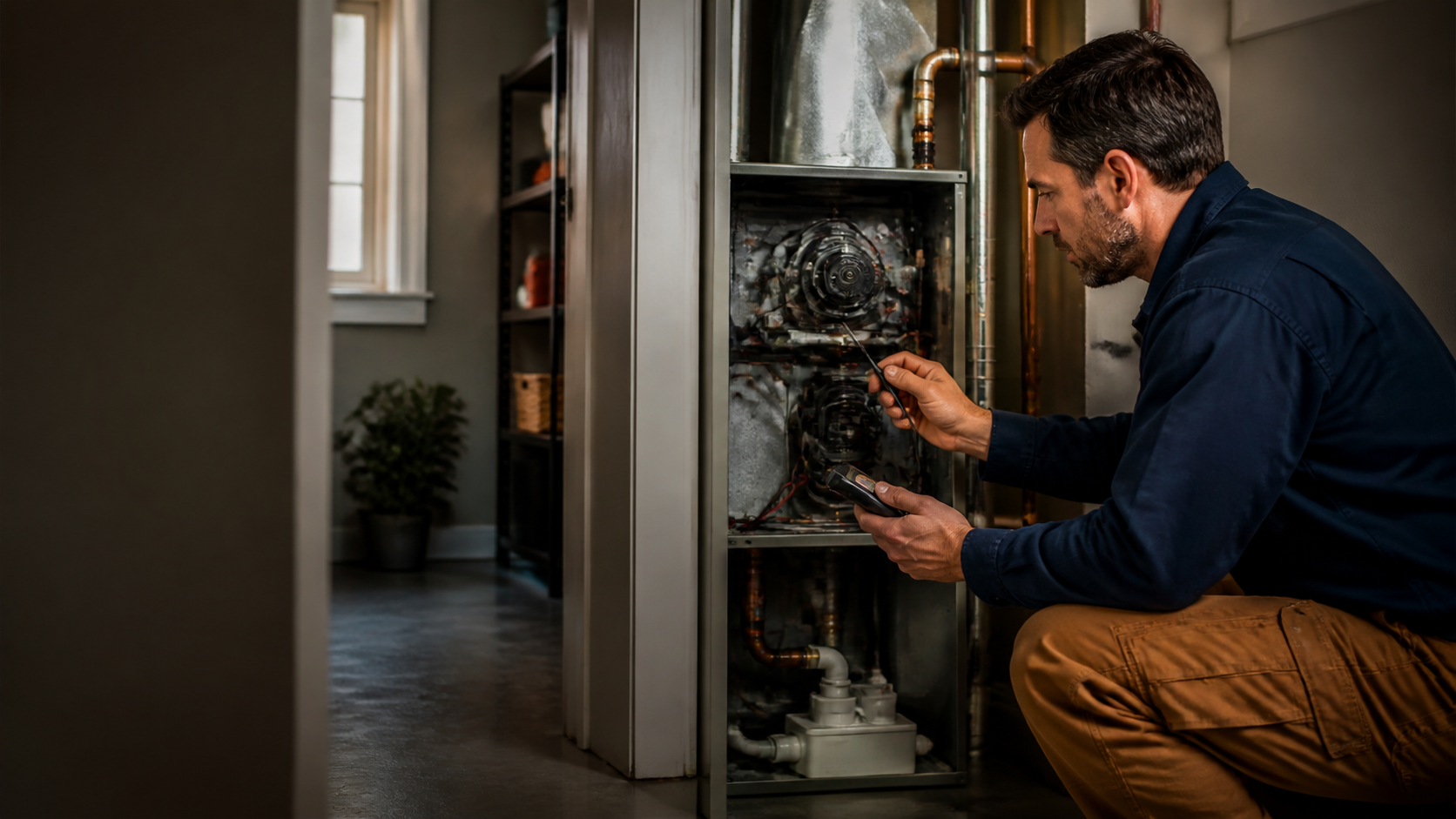
Notice the pattern
Record whether the symptom shows in heat mode, cool mode, or both, plus the sound, thermostat message, outdoor temperature, fan operation, run time, and whether the breaker trips once or repeatedly.
Keep checks safe
Confirm the thermostat, filter, registers, returns, outdoor airflow, and breaker from a safe position. Reset a tripped breaker once, and only with no smell, damage, water, or other warning present.
Do not guess at the part
A capacitor, airflow restriction, low refrigerant, reversing valve, or defrost control can all mimic compressor trouble. Let a technician test before anyone quotes a compressor or a replacement.
What does compressor trouble feel like?
Most people start searching after the outdoor unit grows a new sound or the registers stop delivering. The house stays warm in summer or cool in winter while the unit runs.
It may start and stop repeatedly, hum without starting, trip a breaker, run long, or draw more electricity with no change in weather or habits.
Those details help a technician, and none of them convicts the compressor. Several system problems produce the same experience.
A short video of an unusual sound helps, as long as you stay clear and remove no panels.
Write down when it happens: the operating mode, any thermostat message, the outdoor temperature, whether the outdoor fan runs, how long the system runs, and whether the breaker trips once or again and again.
- Weak heating or cooling while the outdoor unit keeps running.
- A new grinding, rattling, squealing, banging, or humming sound.
- Repeated starts and stops, hard starts, or a hum with no start.
- A breaker trip, longer run times, or higher-than-usual energy use.
- A pattern in heat mode, cool mode, or both.
What else can look like a bad compressor?
The compressor works alongside the thermostat, controls, indoor air handler, blower, outdoor coil, refrigerant circuit, reversing valve, defrost controls, and the electrical parts that spin motors up. A fault in any of them changes what you hear or feel at the registers.
Airflow is the common starting point. A dirty filter, blocked return, closed register, dirty coil, or blower problem makes the heat pump run longer while delivering less.
A plugged condensate drain, the line that carries water off the indoor coil, causes water damage and humidity trouble, though it says nothing about the compressor by itself.
A capacitor problem does a fine compressor impression: a click or a loud hum when the motor cannot get the electrical help it needs to start. Refrigerant and pressure problems are the other reason not to guess, since too much or too little charge cuts efficiency and shortens equipment life, and checking it takes tools and system data.
Reversing-valve and defrost faults round out the list with poor heating, odd ice, or trouble switching between heating and cooling. And do not open the outdoor unit to test a capacitor; they hold a charge after the power is off.
- Airflow restrictions, dirty filters, blocked returns, or blower problems.
- A failed capacitor or another electrical starting component.
- Low or excessive refrigerant charge and related pressure problems.
- Thermostat, control, reversing-valve, or defrost issues.
- A dirty coil or plugged drain affecting system operation.
What can I safely check before calling for repair?
Keep it simple. Confirm the thermostat is set to Heat or Cool as needed with the fan on Auto unless the instructions say otherwise.
Check the filter and service it only as the equipment allows. Make sure registers and returns are not buried.
Look at the outdoor unit from a distance. Leaves, snow, and debris should not block its airflow.
If you clear loose debris, do it with the system off, without bending the coil fins and without removing covers.
A tripped breaker gets one normal reset, and only when there is no burning smell, visible damage, water, or other warning. A second trip means it stays off and the call goes out.
No opening electrical panels, no capacitor testing, no refrigerant measurement or addition, no bypassing safety controls, no forcing a compressor to start.
Ice has its own rule. Light frost can be normal in winter operation; thick ice on the coil restricts heat transfer and signals a problem.
Do not chip it. Turn the system off if it is heavily iced and arrange service, especially if the ice comes back.
- Confirm the thermostat mode and fan setting.
- Inspect the filter, supply registers, and return grilles.
- Keep the outdoor unit's airflow path clear without opening it.
- Reset a tripped breaker once, only when everything else looks safe.
- No panels, refrigerant, electrical testing, or ice chipping.
How is compressor trouble diagnosed?
A useful diagnosis looks at the whole heat pump instead of starting with the compressor is bad. The technician may compare thermostat demand with actual operation, inspect airflow and coil condition, check electrical connections and starting components, and measure operating temperatures and refrigerant conditions against the manufacturer's data.
Sequence matters. If a capacitor, contactor, control, airflow restriction, or refrigerant issue is making the compressor stop or strain, replacing the compressor alone leaves the cause installed.
A fault code or lockout is evidence, not a replacement order.
Before the visit, gather the model and serial numbers if they are visible without removing panels, the system's age if known, the last time it ran normally, the mode the symptom appears in, and any recent filter change, power interruption, storm, remodeling, or water event. Photograph a thermostat code instead of resetting it over and over.
Compressor replacement is not a DIY repair under any theory. It involves specialized tools, electrical testing, refrigerant recovery, and procedures that protect both the new part and the rest of the circuit.
A professional diagnosis tells you what failed, what caused it where that can be established, and what fits the condition of the whole system.
- Compare what the thermostat asks for with what the system delivers.
- Inspect airflow, coils, electrical connections, and starting components.
- Measure operating temperatures and refrigerant conditions as needed.
- Treat fault codes and lockout history as evidence, not orders.
- Ask what failed and what caused it before approving a major repair.
Should I repair or replace the heat pump compressor?
There is no honest universal answer before the diagnosis. Repair fits when the equipment is otherwise sound, the failure is isolated, the service history is reasonable, and the fix restores dependable heating and cooling.
Replacement becomes the serious conversation when the heat pump is older, the repairs keep coming, energy use has climbed, comfort has slipped, or the proposed repair is a large share of the system's value. Age, repeat repairs, rising bills, and stubborn rooms are reasons to evaluate replacement, not commands to replace every aging unit.
Ask whether the diagnosis points at the compressor itself, a related component, or a condition like airflow or refrigerant trouble that needs correcting either way. Ask what happens to the rest of the system too: a new compressor will not fix leaky ducts, thin insulation, blocked airflow, wrong sizing, or a house-envelope problem.
Get the repair cost, warranty status, equipment age, service history, and an honest read on remaining system life in writing. Set that beside a replacement option and choose the path that restores dependable comfort.
- Repair fits a sound system with an isolated failure.
- Replacement earns review when the unit ages or the repairs repeat.
- A compressor repair does not correct duct, insulation, sizing, or airflow problems.
- Compare repair cost, warranty, age, history, and remaining system life.
- Repair-or-replace comes after diagnosis, not from one symptom.
When is compressor trouble urgent in Frederick County?
Shut the system down and arrange help soon if the breaker keeps tripping, the outdoor unit makes a loud mechanical sound, the system is heavily iced, you smell burning electrical insulation, or the equipment overheats or stops repeatedly. Severe loss of heat in freezing weather, or cooling in dangerous heat, also raises the urgency for the household.
If a carbon monoxide alarm sounds, leave immediately, call 911 or local emergency services from outside, and stay out until responders clear it. Do not restart the furnace or another fuel-burning appliance to hunt the source.
A standard electric heat pump compressor is not a source of combustion gas, but many homes run a furnace or other fuel-burning equipment nearby, so the alarm response never changes.
For persistent trouble with no life-safety warning, the next step is a diagnostic visit rather than a part guess. Homeowners in Frederick, Urbana, Walkersville, Middletown, New Market, Mount Airy, and nearby can describe what the system is doing and ask what should be checked first.
The goal is a clear answer: whether the compressor is actually involved, what caused the symptom, and whether repair or replacement fits the equipment and the house. That is how compressor trouble becomes a manageable decision.
- Shut down for repeat breaker trips, burning smells, overheating, or loud mechanical sounds.
- Turn it off and call if the outdoor coil is heavily iced or ices again.
- A CO alarm means leave immediately and call 911 from outside.
- Dangerous indoor heat or cold is urgent for vulnerable household members.
- Persistent but non-dangerous trouble: diagnosis before parts.
The notebook matters here
Mode, sound, message, temperature, fan behavior, run time, breaker history: with a compressor question, the timeline is half the diagnosis, and you are the only one who has it.
Keep it with the system's service file. Patterns that repeat across seasons are exactly what separates a failing compressor from its many impersonators.
- Compressor or copycat? The timeline knows.
And the hard stop
One breaker reset, only with no smell, damage, or water in sight. A second trip ends the experiment and the breaker stays off.
It is a small rule that protects expensive equipment and the person standing next to it.
- One reset, then hands off.
Answers to the usual follow-up questions
What are the signs of heat pump compressor trouble?
Possible signs: weak heating or cooling, unusual outdoor-unit sounds, repeated starts and stops, a hum with no start, longer run times, higher energy use, and a tripping breaker. Airflow, thermostat, capacitor, refrigerant, reversing-valve, and defrost problems can all produce the same picture, so testing matters.
Can a bad capacitor look like a failed compressor?
Yes. A failed capacitor can keep the motor from starting, producing clicking, humming, or hard starts. Do not open the outdoor unit to test it; capacitors hold a charge after power is off. Starting components get tested before anyone condemns the compressor.
What can I safely check before heat pump repair?
Confirm the thermostat mode and fan setting, inspect the filter, open the registers and returns, and check from a distance for debris around the outdoor unit. Reset a tripped breaker once, only with no smell, damage, or water present. A second trip means leave it off.
Is it worth replacing the compressor or the whole heat pump?
It depends on the diagnosis, equipment age, warranty, service history, the condition of the rest of the system, and the repair cost. Repair fits a sound system with an isolated failure. Replacement earns review when the unit is older, repairs repeat, comfort has declined, or the repair is a major share of the system's value.
Is a failing heat pump compressor an emergency?
Turn it off and arrange professional help soon for repeated breaker trips, burning electrical smells, loud mechanical sounds, overheating, repeated stopping, or heavy ice. Dangerous indoor heat or cold raises the urgency. A CO alarm means leave immediately and call 911 from outside.
Should I keep running my heat pump with compressor trouble?
Do not force a struggling system to run. Make the safe checks, stop after a second breaker trip, and shut it down for burned smells, overheating, loud mechanical sounds, or heavy ice. Arrange diagnosis so the cause is confirmed before any compressor or replacement decision.