Gas Smell Near Your Furnace Or Boiler
Get Outside First
A gas smell near the furnace is not a troubleshooting moment. Sulfur, rotten eggs, or any strong gas-like odor in a Frederick County home gets treated as a possible leak: leave the building, take the people and pets, and call for help from a safe distance.
The smell might be the furnace, another gas appliance, a connector, or a gas line. You cannot sort that out safely by following your nose through the house. Getting everyone outside is the first decision; the repair decision comes much later.
This guide covers what to do right now, what the smell may mean, and what a technician can inspect once the utility or responders clear the house. Read the first section before anything else.
Leave the home now
Take everyone and the pets if you can do it without delay. Do not stop to inspect the furnace, find the gas valve, or track the odor to its strongest point. Fresh air, away from the building.
Keep your hands off
No lights or appliances on or off. No thermostat, garage door opener, phone, match, lighter, or anything else inside that could spark.
Call from outside
Away from the building, call 911 for danger, a strong odor, or uncertainty, then call your gas supplier or utility through its emergency process. Re-enter only when they clear the home.
What to do right now
Leave the home immediately, with everyone and the pets if you can do that without delay. Do not stop to inspect the furnace, find the gas valve, or hunt the strongest part of the odor.
Outside is the destination, not the source.
Do not turn lights or appliances on or off, and do not use the thermostat, garage door opener, matches, lighters, or a phone inside the house. Anything that can spark can ignite escaping gas.
Do not stay inside to open windows or gather belongings; ventilation never justifies a slower exit.
Once you are outside and away from the building, call 911 if the odor is strong, someone is in danger, or you are unsure what to do. Then call your gas supplier or utility through its emergency process, and tell them where the odor was strongest and that everyone is out.
Follow the utility's or responders' instructions. Do not go back in to check the furnace, relight a pilot, open windows, or shut off equipment unless a qualified responder specifically tells you how to do it safely.
- Leave immediately with everyone and pets.
- No switches, appliances, thermostat, or garage door opener.
- No phone or flame inside the home.
- Call 911 and the gas supplier or utility from a safe location.
- Re-enter only when qualified responders say it is safe.
What a rotten-egg smell can mean
Natural gas on its own has almost no smell. Suppliers add an odorant called mercaptan so a leak announces itself as sulfur or rotten eggs, and Washington Gas also lists hissing or blowing sounds as a sign that may accompany escaping gas.
The smell does not convict the furnace. A water heater, stove, fireplace, connector, or supply line could be the source, and appliance connectors can wear through movement, bending, or corrosion.
Following the odor around indoors is not a safe diagnostic.
Sometimes a suspected odor turns out not to be an active leak, but that determination is not yours to make from the living room. Qualified utility or emergency personnel decide; treat an uncertain odor seriously and leave.
- Mercaptan supplies the sulfur or rotten-egg warning.
- The furnace may not be the source.
- Hissing or blowing can accompany escaping gas.
- Only qualified personnel can rule a suspected odor an actual leak.
What to do after you are outside
Stay put while the utility or responders assess. Ask when re-entry is safe, and obey that answer rather than the fading of the smell; an odor you can no longer notice does not prove the air is clear.
If the problem lands on the utility's side, they explain what happens next. If it is inside the house or tied to the furnace or boiler, an HVAC professional or other qualified contractor takes over from there.
Either way, gas-leak response precedes furnace repair.
Do not relight the furnace or any gas appliance because the smell weakened. Once the house is cleared, write down what you noticed for the technician: whether the odor arrived at furnace startup, whether there was a bang or hiss, whether the furnace stopped, and whether the smell returned after shutdown.
Those notes support diagnosis but do not replace inspection, and no amount of urgency justifies tightening, disconnecting, testing, or replacing gas components yourself.
- Wait for the utility or responders to assess the home.
- Re-enter on their word, not on the smell fading.
- Do not relight or run the furnace after the odor fades.
- Record observations for the technician once the house is cleared.
Gas smell and carbon monoxide are different hazards
The rotten-egg odor and carbon monoxide are not the same problem. The smell is the odorant warning of possible natural gas.
CO is colorless and odorless, gas- and oil-burning furnaces can produce it, and it can build up indoors.
A house can hold a carbon monoxide danger with no gas smell at all. The symptoms to know are headache, dizziness, weakness, upset stomach, vomiting, chest pain, and confusion.
A CO alarm or any of those symptoms means fresh air and 911, not a return trip to the furnace closet.
CO alarms are a backup, never a substitute for correct installation, venting, maintenance, and repair. Battery-operated or battery-backup detectors belong near every sleeping area, and heating systems deserve annual service from a qualified technician.
- Gas odorant and carbon monoxide are separate hazards.
- CO has no smell and can be dangerous with no gas odor.
- A CO alarm or symptoms means outside, then 911.
- Alarms do not replace equipment service and venting.
When to arrange furnace diagnosis in Frederick County
After the utility or responders clear the house, arrange diagnosis if a continuing odor, delayed ignition, unusual cycling, soot, a damaged vent, repeated shutdowns, or no heat persists. A professional inspection can find electrical and mechanical faults no homeowner should chase.
In Frederick, Urbana, Walkersville, Middletown, or anywhere in the county, a useful call starts with the actual symptom: when the smell occurs, what it resembles, what the furnace does at startup, and what the utility or fire department already checked.
The next step may be a repair, a safety correction, a venting fix, or, with a major component or an aging system, a replacement assessment. The safe diagnosis comes first, and a new furnace is not the automatic ending.
- Arrange diagnosis after clearance if the odor or furnace problem returns.
- Report startup behavior, sounds, cycling, soot, vent damage, or no heat.
- Tell the technician what the utility or fire department already did.
- Get the cause named before any repair-versus-replacement choice.
What a technician checks
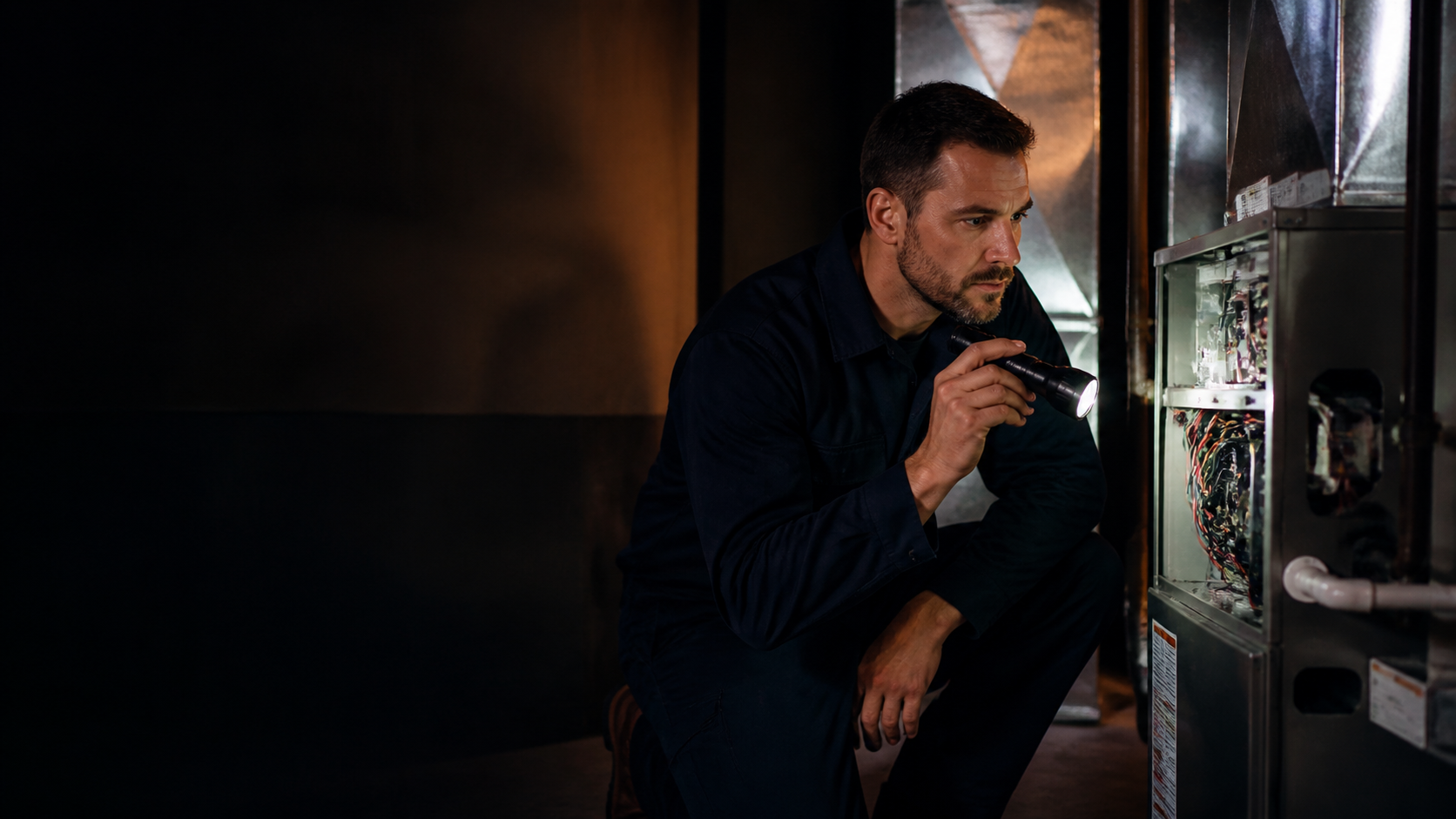
With the house safe to enter, a technician can inspect the gas valve, connectors, nearby fittings, burners, controls, venting, heat exchanger, and combustion path, with the exact scope set by what the utility found and what the furnace was doing.
A useful visit ties the reported symptom to a testable cause. The technician will want to know whether the odor appeared at startup, whether there was a bang or hiss, whether the system stopped, and whether another gas appliance was involved.
Ask what they found before approving repairs: a damaged connector, a faulty valve, a burner problem, and a venting concern take different fixes. Get the cause in plain words and ask how the finished work will be tested before the heat runs again.
- Gas valve, connectors, fittings, burners, and controls.
- Venting, the heat exchanger, and the combustion path as appropriate.
- The inspection follows the startup behavior and your observations.
- Cause, repair, and safety test explained before approval.
One instruction, one time
Everything above reduces to a single move: smell gas, leave, call from outside. No inspection, no valve, no strongest-spot search on the way out.
Keep the response simple enough to execute at 3 a.m.
Everyone out, calls made from a distance, and the furnace conversation saved for after the clearance.
- Out is the only destination.
Answers to the usual follow-up questions
What should I do first if I smell gas near my furnace?
Leave immediately with everyone and pets. Do not turn lights or appliances on or off, touch the thermostat, use a phone, or light anything inside. From outside and away from the building, call 911 if anyone is in danger or you are unsure, then call your gas supplier or utility. Stay out until qualified responders say it is safe.
What should I do first if I smell gas near my furnace?Why does my furnace area smell like rotten eggs?
Gas suppliers add mercaptan, an odorant that smells like sulfur or rotten eggs, to warn about possible natural-gas leaks. The furnace may not be the source; another appliance, connector, or gas line could be involved. Leave and call from outside rather than following the odor indoors.
Why can't I turn off the lights or use my phone during a gas leak?
A light switch, thermostat, garage door opener, phone, or other electrical action can create a spark. Operate nothing inside near a suspected leak. Leave first, then make every call from outside and away from the building.
Should I try to relight the pilot or shut off the gas myself?
No. Do not relight a pilot or touch gas components while you smell gas, and do not search for the appliance valve. Leave the home and follow the gas supplier's or emergency responders' instructions from a safe location.
Is it safe to run my heat after the gas smell goes away?
No. A fading odor does not prove the home or the furnace is safe. Wait for the gas utility or emergency responders to clear the house, then arrange a qualified inspection before running the furnace or boiler again.
Is it safe to run my heat after the gas smell goes away?Does a carbon monoxide alarm detect a gas leak?
No. A CO alarm warns about carbon monoxide buildup; it does not make a suspected natural-gas odor safe to ignore. Use the gas-leak response for a gas smell, and treat a CO alarm or possible symptoms as its own emergency: outside, then 911.