What Are the Most Common Furnace Problems?
When a furnace acts up, you rarely get a clean part name. What you get is a symptom: it won't start, it blows cool air, it runs in short bursts, it makes a new sound, one room stays cold, or the blower keeps running after the heat shuts off. A dirty filter causes a lot of this because it chokes airflow, but the same symptom can trace back to the thermostat, the power supply, the ductwork, the blower, the ignition system, or a safety control. Carrier's furnace troubleshooting guide calls a dirty or clogged filter the most common furnace problem, and lists several others behind it.
That's why the symptom isn't the diagnosis. We want to know what changed and when. You can make a few safe observations at home, but don't guess whether the igniter, flame sensor, limit switch, gas valve, or heat exchanger failed. The next step depends on what you saw and whether it came with a safety warning.
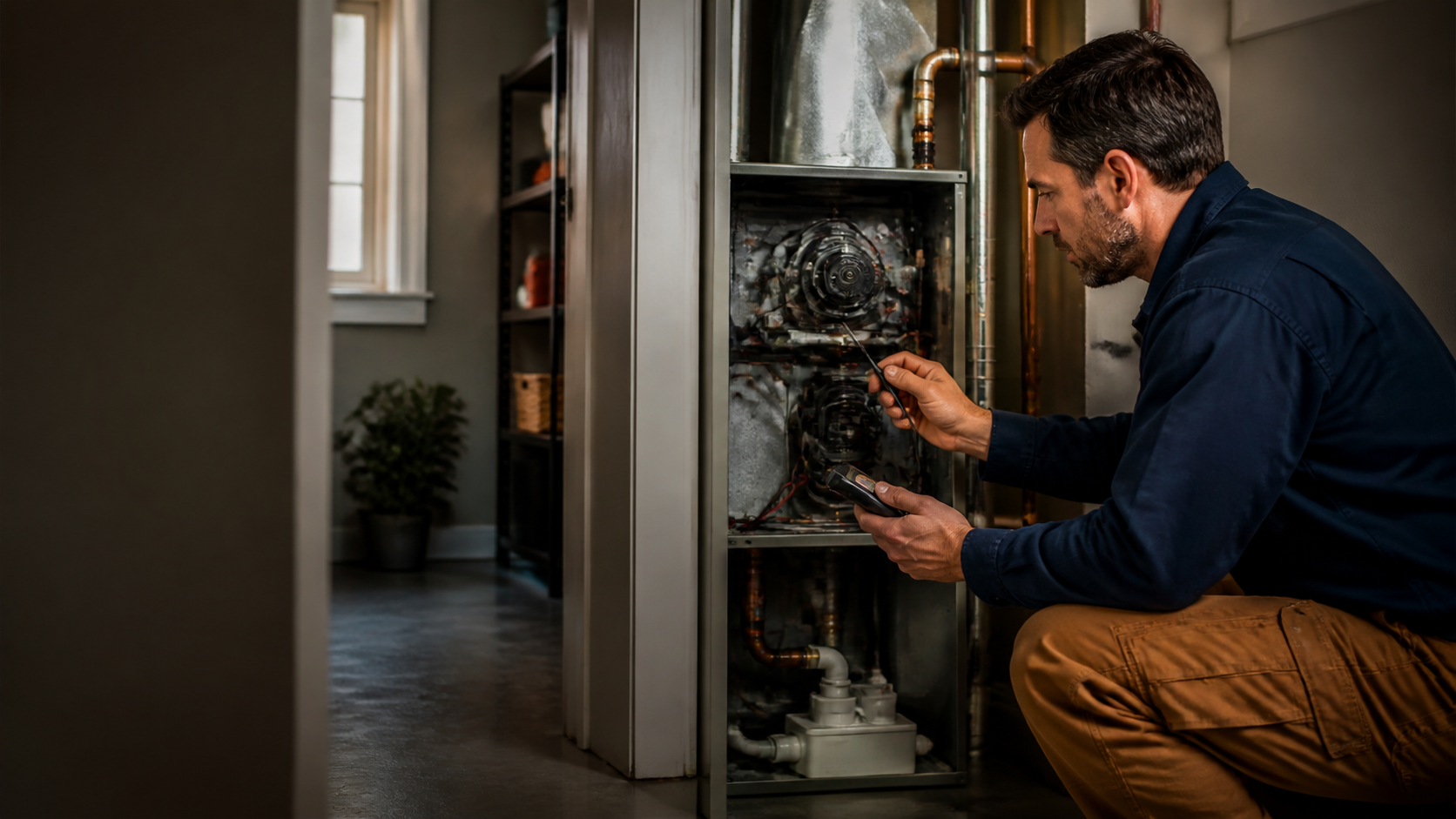
Common furnace symptoms and what they can point toward
| What you notice | What it may involve |
|---|---|
| The furnace will not turn on | Thermostat settings, power, filter condition, controls, or another fault |
| The blower runs but the air feels cool | Operating mode, ignition, heat sequence, blower timing, or airflow |
| Airflow is weak or uneven | Filter, return path, supply registers, blower, or ductwork |
| The furnace starts and stops quickly | Thermostat, restricted airflow, ignition, flame sensing, or a limit safety |
| It clicks, bangs, rattles, whistles, or squeals | Ignition, loose panels or ductwork, a filter restriction, or another component |
| Water appears near the equipment | A blocked drain or a condition needing prompt inspection |
The most common furnace problems at a glance
Most calls we get sound like one of these: the furnace won't turn on, the thermostat is blank, the blower runs but nothing feels warm, airflow is weak in part of the house, the furnace short cycles, a new noise shows up, water collects near the unit, or the blower never shuts off. A gas smell, burning material, or a carbon monoxide alarm changes the situation instantly. That's not troubleshooting anymore.
Those descriptions point us somewhere, but they aren't a diagnosis on their own. Write down when the symptom started, whether it happens every cycle, what the thermostat shows, and whether every register feels the same. A clear pattern gives us a better starting point than a guessed part name.
- Note whether the problem affects the whole home or only some rooms.
- Record what happens when the furnace tries to start and how long it runs.
- Stop troubleshooting for gas odor, a carbon monoxide alarm, smoke, or immediate electrical danger.
Why is my furnace not turning on?
Start with what doesn't require opening the furnace or touching wiring. Confirm the thermostat is set to Heat and the target temperature sits at least 5 degrees above the room's actual temperature. Get that setting wrong and the furnace never gets a heating call in the first place, per Trane's furnace ignition guidance.
Next, check the display. A blank screen can mean dead batteries, a power interruption, or something that needs us to look at it. If your thermostat runs on batteries, swap them per the manual. Carrier lists thermostat mode, the furnace power switch, and filter condition among the first things to check when a furnace won't run at all.
Pull the filter without reaching into the cabinet. If it's visibly loaded with dust, swap it for the right size, or clean it if the manufacturer allows that. ENERGY STAR recommends checking HVAC filters monthly and notes a dirty one can raise energy costs and damage equipment.
If a breaker trips a second time, leave it off. Don't keep flipping it to force the furnace to run. Trane says to call for help once a breaker trip may signal a furnace problem, and a repeat trip is evidence the system needs a look, not an invitation to keep testing the circuit.
- Check the thermostat mode and display.
- Look at the filter without opening the furnace.
- Leave a breaker off if it trips again.
What causes weak airflow, cold air, or short cycling?
Weak airflow usually starts at the filter, but it doesn't stop there. A dirty or clogged one can cut airflow, run the furnace longer, wear the motor, and burn more energy doing it. Department of Energy filter guidance explains why an overdue filter drags down both air movement and the equipment behind it.
Check that supply registers are open and not buried under furniture, rugs, or boxes. Check the return grilles too. A blocked return can starve the whole system of air even while the furnace runs. Weak airflow can also mean a blocked or separated duct, disconnected ductwork, or a return path that's too tight for the system.
Short cycling is when the furnace fires, runs 2 or 3 minutes, and shuts off before the house reaches the thermostat setting. Carrier points to thermostat placement or settings, a restricted filter, and blocked vents as common contributors. A dirty filter can also choke airflow enough to overheat the furnace and trip a safety limit, which leaves the blower running after the burners stop. Trane's blower guidance covers another reason a fan keeps running.
Don't close off several vents to push more heat into one room. That raises pressure in the ducts and can feed the same overheating and short-cycling problem. Filter clean, registers open, furnace still cycling fast? Call us. Guessing at parts on a symptom alone wastes your money.
- Keep supply registers and return grilles open and clear.
- Treat repeated short cycling as a diagnosis issue, not a reset routine.
- Do not close several vents to force more heat into one room.
What furnace problems involve ignition or the burner?
Clicking with no flame, or a furnace that starts and stops fast, usually means the lighting process isn't finishing. Depending on the furnace, that can point to an electronic igniter, an older standing pilot, a flame sensor, the control board, fuel delivery, or another safety control. A failed igniter is a common reason a newer furnace won't light. Trane's ignition guide covers this whole symptom group.
Sometimes it looks like the furnace lights for a second, shuts down, and leaves the blower pushing cool air around the house. That can involve airflow, the thermostat, or ignition itself, so it needs us to look rather than a guess at a replacement part.
Don't pull the burner assembly, clean a sensor, adjust gas pressure, relight a pilot outside the manual's instructions, or bypass a safety control yourself. Gas, combustion, and ignition work need someone who can test the whole sequence safely. Call us for that.
- Describe whether you hear clicking and how long the burners stay lit.
- Do not open the burner compartment or adjust gas controls.
- A component name is not the same as a diagnosis.
What do furnace noises, water, and a constantly running blower mean?
A new sound is worth writing down. Whistling often points to a clogged filter or a gap in the ductwork, while rattling usually means loose ductwork or panels. A loud bang when the furnace starts can mean delayed ignition, and that one needs us out quickly. Carrier's furnace troubleshooting guide walks through several sound-related checks. What we need is the timing, not a confident guess about the motor or belt.
If the blower never shuts off, check whether the thermostat fan setting sits on On instead of Auto. Trane notes the On setting keeps the fan running even when the furnace isn't making warm air. If it's already on Auto and the fan still won't stop, the filter, safety controls, thermostat, or blower may need our attention.
Don't ignore water near a furnace. A plugged drain can cause real water damage and push indoor humidity up. ENERGY STAR maintenance guidance backs prompt attention to drainage and equipment condition. Shut off the equipment if water is reaching electrical parts, move belongings out of the way if you can do it safely, and call us. Don't open panels or work near wiring in a wet mechanical closet.
- Record whether a noise happens at startup, during operation, or at shutdown.
- Check the thermostat fan setting without opening the equipment.
- Keep water away from electrical components and arrange an inspection.
Which furnace warning signs are urgent?
Leave the house and get emergency help if you smell natural gas. That sulfur-like, rotten-egg odor means a leak. Natural gas safety guidance says to get out immediately and call 911 from a safe spot. Warn anyone else in the house, and don't flip switches, use your phone, or light anything inside the suspected area.
Carbon monoxide is the other hard stop. You can't smell it or see it, and gas- or oil-burning furnaces can produce it. If a CO alarm sounds, get outside right away and call the fire department. Don't go back in until they tell you it's safe. CDC carbon monoxide guidance and CPSC alarm guidance cover these precautions in more detail.
Stop troubleshooting and call us for a burning electrical smell, visible soot, a loud bang at startup, repeated breaker trips, a furnace that keeps locking out, or anything that looks like a heat exchanger or venting problem. You don't need to know which part failed before you ask for help.
- Gas odor: leave, warn others, and call 911 or the gas utility from outside.
- CO alarm: get outside and call the fire department; do not re-enter until cleared.
- Smoke, soot, sparking, or a burning electrical smell: stop and get help.
When should I schedule furnace maintenance or repair?
If your furnace is running fine, keep up with monthly filter checks and one seasonal maintenance visit. ENERGY STAR recommends a pre-season checkup each year, with heating equipment checked before the cold sets in. Got a no-heat, cold-air, airflow, noise, water, or short-cycling problem that won't quit? Call us. Write down the thermostat setting, when it happens, what you hear or smell, and what you've already checked.
If the furnace is getting older and needs frequent repairs while your bills climb, ask us for a straight repair-versus-replacement conversation. ENERGY STAR lists frequent repairs and rising energy bills as signs the equipment may be losing efficiency. The condition of the unit and the scope of the repair should drive that call, not the calendar.
We cover furnace repair, emergency service, maintenance, installation, and indoor air quality for homeowners across Frederick County, Maryland. Tell us what the furnace is doing rather than naming the part you think failed. A clear symptom gets us to the real problem faster, whether that's a filter, an airflow issue, a control, or a bigger equipment decision.
- Normal operation: plan seasonal maintenance and regular filter checks.
- Persistent symptoms: schedule diagnosis and bring the symptom timeline.
- Frequent repairs and rising bills: ask for a clear repair-versus-replacement explanation.
Questions that come up next
What are the most common furnace problems?
We hear about no heat, weak airflow, cool air, short cycling, ignition trouble, new noises, water near the equipment, a blower that won't stop, and outright safety warnings. Any of these can have more than one cause behind it, so we still test the operating sequence rather than guess.
Which furnace checks can I do myself?
Confirm the thermostat is calling for heat, check a visibly loaded filter, and make sure registers and returns aren't blocked, as long as nothing feels unsafe. Don't bypass controls, open gas components, or keep resetting a system that keeps failing on you.
Why does my furnace start and then stop?
Ignition, flame sensing, airflow, thermostat settings, or a tripped safety switch can all cause that. If it keeps shutting down on repeat cycles, call us instead of resetting it again.
When is a furnace problem an emergency?
Get out first for a gas odor, a CO alarm, smoke, fire, sparking, or any immediate electrical danger. Call 911 or the gas utility from outside and don't go back in until officials clear the house.
Need HVAC help in Frederick?
Tell us what the system is doing and what you've checked already. If it needs a visit, we'll say so.