Oversized HVAC System Symptoms
What Homeowners Should Look For
Here's the strange part about an oversized HVAC system: it can heat or cool the house fast and still leave the house uncomfortable. The tell is rhythm, not temperature — the equipment fires up, satisfies the thermostat, shuts down, and does it all again before the rooms ever even out. In summer, one room ends up cold while another stays warm and sticky.
Oversized simply means the equipment carries more heating or cooling capacity than the house needs under the conditions it's facing. And the right size comes from the home's actual loads, not from square footage on a real estate listing. A load calculation is where the question gets answered.
These symptoms point toward oversizing; they don't prove it. Filters, airflow, ducts, controls, and refrigerant can stage the same show — so a real diagnosis weighs the equipment, the distribution system, and the house together.
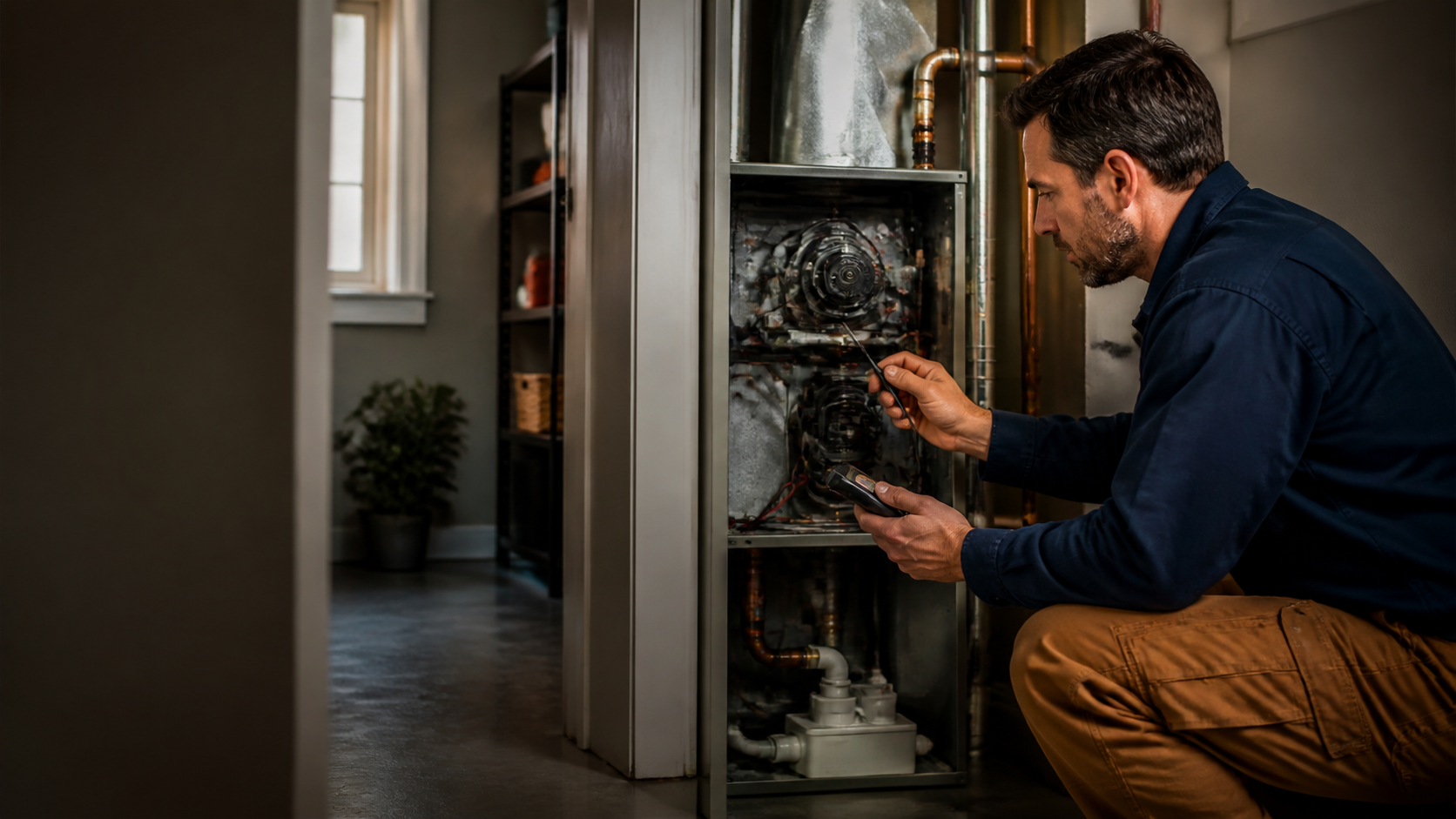
The pattern
The equipment satisfies the thermostat fast, shuts off, and restarts soon after. Rooms still feel uneven, and cooling leaves the air cold but damp or clammy.
What it does not prove
Short cycling also comes from a dirty filter, restricted airflow, duct defects, controls, refrigerant, or another fault. The symptom opens an investigation; it doesn't close one.
The useful check
Ask for the home's heating and cooling loads, the equipment's actual capacity, measured airflow, duct condition, and operating details. A same-size swap is not a sizing review.
What does an oversized HVAC system mean?
Keep two words apart: capacity is what the equipment can deliver, and load is what the house is losing or gaining. When capacity towers over the current load, the thermostat gets satisfied almost instantly — and a fast thermostat is not the same thing as an even house.
Short runs also shortchange the parts of comfort that need time: circulation through every room, and moisture removal that only happens while air keeps moving across the coil. Rules of thumb built on square footage are exactly how oversizing happens in the first place.
The real test is whether the system matches the home's true load and behaves across the whole season. A model number or a tonnage figure can't answer that by itself.
- Capacity is what the equipment delivers; load is what the home needs.
- Sizing follows the home's characteristics, not square footage alone.
- Fast thermostat satisfaction is not even comfort.
- A sizing review should show its work — assumptions and calculations included.
What are the most common oversized HVAC system symptoms?
The signature is short cycling — the system runs briefly, shuts off, and starts again within minutes. One short cycle means nothing; a repeated pattern paired with poor comfort means everything.
The thermostat reaches its target quickly while the rooms tell a different story. Outdoor temperature, controls, airflow, and the load of the moment all bend cycle length, so don't turn a stopwatch into a verdict.
Treat the symptom as a question for a professional, not a part order. It tells you what to ask someone to check — it doesn't identify the failed component or convict the equipment of oversizing.
- Frequent on-and-off instead of longer, steadier run cycles.
- Thermostat satisfied fast; rooms still uneven.
- A chilly patch near a register while the rest of the house never settles.
- Cooling that leaves the air cold but damp or clammy.
- The pattern repeating even though the thermostat reads satisfied.
Why can a system leave a home cold but humid?
Air conditioning does two jobs at once — dropping temperature and squeezing out moisture — and the second one runs on the clock. Water has to condense on the coil and drain away, cycle after cycle.
An oversized system hits the thermostat and quits before much dehumidifying ever happens, leaving air that's cold at the register and sticky in the room.
Humidity alone doesn't finger an oversized system either. Poor airflow, duct issues, filters, ventilation, leaks, drainage, and indoor moisture sources all move the needle.
A ten-dollar humidity gauge tells you whether the problem is occasional or chronic.
When humidity stays high, the evaluation belongs to the whole system and the whole house — not to the number on the thermostat.
- Short cooling cycles drop temperature without removing enough moisture.
- Cold at the register, sticky in the room — the classic mismatch.
- Airflow, ductwork, coils, drainage, sealing, and insulation each need their own check.
- A humidity reading shows whether the issue is sporadic or persistent.
How do you tell whether an HVAC system is actually oversized?
A serious evaluation starts with the house, not the data plate. Ask how the heating and cooling loads were calculated, how they compare with the equipment's actual capacity and performance, and whether the airflow reaches the far rooms the way the design intended.
The inspection should sweep the rest of the system too: filters, coils, blower operation, controls, refrigerant charge, and any ducts crossing attics or crawl spaces. Leaks, missing insulation, restrictions, and weak return paths can manufacture hot and cold rooms even when the equipment size is innocent.
Your homework: note the outdoor conditions, thermostat setting, run behavior, humidity readings, and any recent improvements to the house. A credible sizing range should be explainable — assumptions, calculations, and all.
- Review the home's heating and cooling loads.
- Compare those loads with actual equipment capacity and performance data.
- Check airflow through the equipment and into the rooms.
- Inspect filters, coils, blower operation, controls, and refrigerant charge.
- Hunt duct leaks, missing insulation, restrictions, and weak return paths.
- Record outdoor conditions, thermostat setting, humidity, run behavior, and recent upgrades.
Can an oversized HVAC system be repaired, or does it need replacement?
It depends entirely on what the evaluation finds. If the short cycling traces to a clogged filter, an airflow restriction, a control fault, a refrigerant issue, duct leakage, or a drainage problem, maintenance or repair may end the story — same equipment, different behavior.
If the equipment is genuinely too large for the home's load, you've arrived at a design decision. The path forward might mean equipment selection, duct changes, controls work, or replacement.
Ask what load was calculated, what capacity it was compared against, what airflow was measured, and which other causes were ruled out.
Replacement timing sharpens when a confirmed mismatch overlaps with age, repeat repairs, climbing energy bills, or a major component failure — and even then it's a timing decision, not a reflex. Note that variable-capacity equipment still demands correct sizing and installation.
- Repair or maintenance fits when another fault is staging the symptom.
- Confirmed oversizing is a design question, not a part swap.
- Ask for load, capacity, airflow, and ruled-out causes in plain language.
- Age, repeated repairs, rising bills, and major failures move the timing.
Why does the right HVAC size depend on the Frederick County home?
No two houses around here present the same load. An older Frederick farmhouse, a renovated split-level, a newer build, and a home with a finished addition carry different insulation, windows, duct layouts, air leakage, and room-use patterns.
A system that fit before an insulation upgrade may be oversized the day after it.
Square-footage rules make a weak foundation. Bring the equipment model and age if you have them, recent comfort changes, humidity readings, home improvements, and the repair history into the sizing conversation.
The house in front of the technician outranks any same-size-swap instinct. A well-sealed, efficient home can carry a load small enough to fall below some manufacturers' smallest capacity — which makes the selection conversation more important, not less.
- Older, renovated, newer, and expanded homes each carry their own load.
- Insulation, windows, duct layout, air leakage, and room use all shape sizing.
- An enclosure upgrade can change the load without touching the equipment.
- Bring model, age, comfort changes, humidity readings, upgrades, and repair history.
What should you do if you suspect an oversized HVAC system?
Write the pattern down instead of guessing at a part: short cycles, uneven rooms, clammy air, humidity readings, filter changes, home improvements, any new noise or water. If the system is failing outright or comfort has collapsed, don't wait — request timely help.
For a sizing question specifically, ask for a diagnosis that weighs load, capacity, airflow, ducts, controls, and drainage together. A healthy system that keeps leaving the house uncomfortable may just need maintenance or a focused diagnosis before anyone utters the word replacement.
When age, repeat failures, or a confirmed capacity mismatch tip the scales, ask for a replacement evaluation built on the home's current load. In Frederick County, the answer should fit the house actually standing in front of you.
- Record cycle behavior, affected rooms, clamminess, humidity, filters, and recent changes.
- Ask that load, capacity, airflow, ducts, controls, and drainage be weighed together.
- Don't treat short cycling as proof of oversizing.
- Let the findings choose between repair, airflow or duct correction, maintenance, or replacement.
Watch the rhythm for a week
How long does the system run? How long between restarts?
Which rooms miss out? Does the air feel clammy?
What does the thermostat show? One week of honest notes on the pattern is worth more to a sizing review than any single afternoon's impression.
Keep the log with the system's records — patterns are what turn a vague complaint into a solvable problem.
- Runtime, gap, restart, repeat: the four numbers that sketch the story.
Answers to the usual follow-up questions
Does short cycling prove my HVAC system is oversized?
No. Oversizing is one candidate among several — a dirty filter, restricted airflow, a control issue, a refrigerant problem, a duct defect, or another fault can all produce the same rhythm. Short cycling earns an investigation, not a jump to a verdict.
Is a larger HVAC system more efficient?
Not automatically. A bigger system satisfies the thermostat quickly but runs less steadily, and steady running is where efficiency and comfort live. Equipment selection starts with the home's load and the system's operating range — not with the biggest capacity on the truck.
Do heat pumps and furnaces need the same sizing review?
Both need matching to the home. A proper sizing review accounts for the equipment type, its capacity range, the controls, and what the house actually demands for heating or cooling.
Can humidity stay high even if the thermostat is satisfied?
Yes. A brief cooling cycle can drop the temperature without running long enough to remove moisture. Airflow, ductwork, drainage, ventilation, and indoor moisture sources all contribute too. Persistent humidity deserves a specific dehumidification and HVAC evaluation.
What does an oversized HVAC system mean?
It means the equipment's capacity — what it can deliver — substantially exceeds the home's load, which is what the house is losing or gaining at a given moment. The system satisfies the thermostat almost instantly, but a fast thermostat has never once meant an even, comfortable house.