Uneven Temperature After HVAC Repair
What to Check Next
If one room is still hot while another feels comfortable after an HVAC repair, the repair may have corrected one equipment fault without solving the whole comfort problem. A thermostat, filter, supply register, return path, duct connection, insulation problem, or room exposure can still affect what each space feels.
That does not automatically mean the original repair was wrong. It does mean the remaining symptom needs a complete follow-up diagnosis, especially if the house is still uncomfortable, the system runs much longer than before, or airflow changed after the visit.
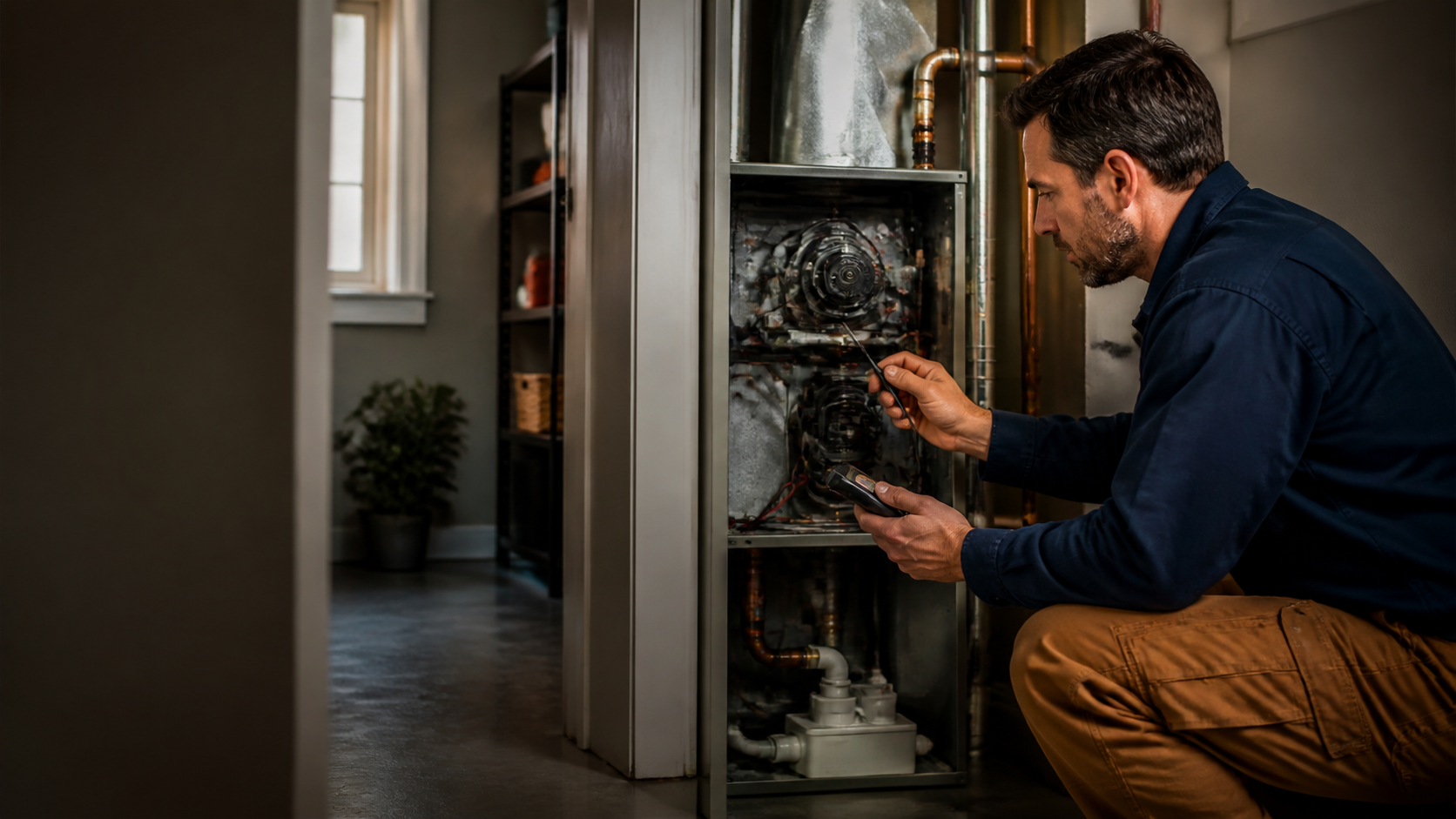
Start with the room pattern
Note which room is hot or cold, when it happens, whether the thermostat reaches its setting, and whether airflow changed after the repair. Those details help separate a delivery problem from a control or room-load problem.
Check only the safe air path
Look at the filter, supply registers, and return grilles without opening the equipment. Do not touch wiring, refrigerant lines, gas controls, burners, or combustion components.
Know when to call promptly
No airflow, spreading water, repeated ice, repeated breaker trips, or lost heating or cooling in severe weather needs prompt service. Gas odor, smoke, a CO alarm, or a burning electrical smell is an immediate safety issue.
Why rooms can stay hot or cold after a repair
An HVAC repair is usually aimed at a specific fault. Replacing or correcting that part can restore heating or cooling while leaving a separate distribution problem untouched.
The equipment may produce conditioned air, but the air still has to travel through the duct system, leave through the right registers, and return to the system in a way that supports normal operation.
The thermostat adds another layer. If it is in a hallway or a room that reaches the set temperature quickly, the system may shut off while a distant bedroom, finished attic, addition, or sunny room remains uncomfortable.
Look at control location and air delivery together before guessing that the compressor, furnace, or heat pump has failed again.
The home itself matters, too. Windows, insulation, air leaks, ceiling height, solar exposure, and a room over a garage can change how much heating or cooling that space needs.
Equipment maintenance, insulation, air sealing, duct condition, and thermostat settings work together to shape comfort.
- A repaired component can leave a separate distribution problem untouched.
- A thermostat can shut the system off while a distant room remains uncomfortable.
- Windows, insulation, air leaks, exposure, and room location change the load.
- Uneven comfort does not prove the original repair was wrong.
Safe checks before you call the HVAC company back
You can gather useful information without opening the equipment cabinet or touching wiring, refrigerant lines, gas controls, burners, or combustion components. Make these observations only when the system is running normally.
Compare the thermostat reading with the temperature in the problem room. Check whether the filter is dirty and replace or clean it only as the equipment and filter instructions allow.
Confirm that supply registers and return grilles are open and not blocked by furniture, rugs, curtains, or stored items.
Record when the uneven temperature appears: afternoon sun, overnight, very cold weather, or every time the system runs. Note any new water near indoor equipment or visible ice on an accessible line, but do not chip away ice or remove panels.
Write down what repair was completed, when the symptom returned, which rooms are affected, and whether the system cycles differently.
- Compare the thermostat with the temperature in the problem room.
- Check the filter and follow the equipment instructions before replacing it.
- Open and clear supply registers and return grilles.
- Record timing, affected rooms, airflow changes, water, ice, and repair details.
Could the ducts or returns be the problem?
Yes. Supply ducts carry conditioned air from the air handler to registers.
Return ducts and grilles carry room air back to the system. If a supply connection is loose, a duct is damaged, or a return path is restricted, the equipment can run while the intended room receives less useful airflow.
Duct leakage is especially worth discussing when rooms still feel different after the repaired equipment is operating, when one register has noticeably weak airflow, or when ductwork runs through an attic, crawlspace, garage, or another unconditioned area. Ducts in those spaces can lose heating and cooling capacity before the air reaches a register.
The return side deserves equal attention. A room may have a supply register but no easy path for air to return when the door is closed.
Furniture can cover a return grille, and a filter slot or return connection can leak. Ask for the air distribution system to be considered as part of the diagnosis rather than guessing with tape, tools, or equipment panels.
- Loose supply connections and damaged ducts can starve a room of airflow.
- Ducts in attics, crawlspaces, garages, and other unconditioned areas can lose capacity.
- A closed door or blocked grille can restrict the return path.
- Ask the technician to inspect and measure the air distribution system.
When sizing, controls, insulation, or humidity matter
Room patterns can point toward a home or system factor that was not part of the original repair. A second-floor room that heats up in summer, a bedroom over a garage that loses heat in winter, or an addition at the far end of the duct system may need a different evaluation from a room beside the thermostat.
Those patterns do not prove incorrect sizing; they show where the comfort investigation should look.
Ask whether the control strategy matches the way the home is used when the system stops as soon as the thermostat area is comfortable. If the complaint is limited to one or two rooms, ask whether airflow measurement, duct inspection, or a return-path check would be useful before discussing replacement.
Insulation and air sealing can matter as much as the equipment in a problem room. Long ducts can lose heat or gain heat as they cross unconditioned spaces.
Humidity can also make a room feel wrong even when the temperature number looks close. Indoor humidity should stay below 60 percent, ideally between 30 and 50 percent.
A stronger filter is not a universal fix for a room that is still hot, cold, or weakly supplied.
- A room over a garage or at the end of a long run may need a wider evaluation.
- Thermostat location and control strategy can stop the system too soon for a distant room.
- Insulation and air sealing affect the comfort delivered to a room.
- Humidity can make a room feel wrong even when the temperature looks close.
What to ask for on a repair callback
Describe the symptom in room terms: the upstairs bedroom is still hot after the repair, the hallway reaches the thermostat setting, and airflow at that register feels weak. Include the date of the repair, the condition before and after the visit, and anything that changed.
This is more useful than naming a part you think failed.
Ask whether the follow-up can evaluate the repaired component along with system operation and air distribution. Depending on the equipment and access, that discussion may include supply and return airflow, filter and blower condition, controls, duct connections, refrigerant or combustion safety checks, and the room conditions that affect load.
If the system is stable but the house remains uncomfortable, a focused HVAC diagnosis is usually the right next step. It can show whether the remaining problem is equipment operation, delivery, controls, or the home.
Replacement may be appropriate later if the system, distribution, or repeated repair history makes that decision reasonable. It should not be the first conclusion drawn from one uneven room.
- Describe the affected rooms, timing, thermostat behavior, and airflow in plain terms.
- Ask for the repaired component and air distribution to be evaluated together.
- Ask whether airflow, ducts, controls, and room conditions need measurement.
- Treat replacement as a later decision supported by the diagnosis.
When uneven comfort becomes urgent
Call promptly when the system has no airflow, water is spreading near equipment, ice keeps forming, the electrical breaker trips repeatedly, or the home is losing heating or cooling during severe weather. Turn off equipment that is behaving unsafely and avoid repeated resets while waiting for professional guidance.
Treat a carbon monoxide alarm, smoke, a gas odor, or a burning electrical smell as a safety issue, not a room-temperature puzzle. If a CO alarm sounds, move outside, call emergency services or the fire department, and do not go back inside until responders say it is safe.
Do not service fuel-burning appliances without the proper knowledge, skill, and tools.
For a Frederick County home that is still uncomfortable after HVAC work, bring your room list, temperature observations, airflow notes, filter information, and repair details to a local HVAC diagnosis. The goal is a clear explanation of what changed, what still needs attention, and whether the next move is a targeted repair, an air distribution correction, maintenance, or a larger home comfort evaluation.
- Call promptly for no airflow, spreading water, repeated ice, or repeated breaker trips.
- Severe weather can make loss of heating or cooling more urgent.
- Leave first for a CO alarm, smoke, gas odor, or burning electrical smell.
- Bring your room list, temperature observations, airflow notes, and repair details.
Name the room, not the part
'The northeast bedroom is still hot at 3 p.m.
, the hallway thermostat says 72, and that register feels weak' — that one sentence is a work order. Which room, which hours, what the thermostat says, what the air feels like.
The repair invoice date belongs in the same note. Symptoms that came back a week after a repair and symptoms that never left are two different stories.
- Room, hours, thermostat, airflow, repair date — one sentence.
Where the homeowner checklist stops
Filter, registers, return grilles — look, don't open. The moment a check needs the cabinet off or a wire touched, the callback conversation starts instead.
Wiring, refrigerant lines, gas controls, burners, and combustion parts stay covered for a reason. The follow-up visit exists precisely so those get checked with the right tools.
- Look at the air path; leave the equipment sealed.
Answers to the usual follow-up questions
Why is my house still uncomfortable after HVAC repairs?
A repair may correct one equipment fault while leaving a separate comfort problem in the ducts, return path, thermostat location, insulation, humidity, or the room itself. Compare the thermostat with the affected room and ask for the repaired component and air distribution to be checked together.
Are uneven rooms a duct problem or an equipment problem?
Either is possible, and the room pattern helps decide where to look. Weak airflow, a duct that travels half the house, a blocked return, or a closed door can point to delivery. A room over a garage, poor insulation, humidity, or a control that shuts off too soon may require a wider home-comfort evaluation.
Are uneven rooms a duct problem or an equipment problem?What can I check before calling the HVAC company back?
Compare the thermostat with the problem room, check the filter, confirm supply registers and return grilles are open, and record when the symptom appears. Do not open equipment or touch wiring, refrigerant lines, gas controls, burners, or combustion components.
Can the wrong system size cause comfort problems?
Sizing can matter, but an uneven room does not prove the system is wrong-sized. Ask the technician to consider airflow, duct condition, controls, insulation, humidity, and room exposure before discussing replacement.
Can the wrong system size cause comfort problems?Should I replace the system because one room is still hot?
Not as a first conclusion. A focused follow-up can show whether the remaining problem is equipment operation, delivery, controls, or the home. Replacement may make sense later when the system, distribution, or repeated repair history supports it.
When is an uneven-temperature problem urgent?
Call promptly for no airflow, spreading water, repeated ice, repeated breaker trips, or loss of heating or cooling during severe weather. Leave the home and call emergency services from outside for a carbon monoxide alarm, smoke, gas odor, or burning electrical smell.