Why Is My Heat Pump So Noisy? A Frederick Homeowner's Guide
No heat pump is silent. The outdoor fan has a voice, the compressor has one, airflow has one, and the whole unit shifts its tone for a moment whenever it swaps between heating and cooling. What deserves your attention is different: a sound that's new, or much louder than usual, or that hangs on after startup, or that arrives with shaking, or that shows up right as the heating or cooling gives out.
So if the thing outside suddenly grinds, buzzes, rattles, hisses, or screeches, treat the sound as a symptom — not as a verdict on any one part. Describing it well helps a technician find the cause fast. Opening the unit to check electrical or refrigerant components yourself does the opposite, and it isn't safe.
Context: a short hum or whoosh during a winter defrost is ordinary. A normally quiet unit that turns loud, stays loud, or shudders hard is asking for a professional's ears.
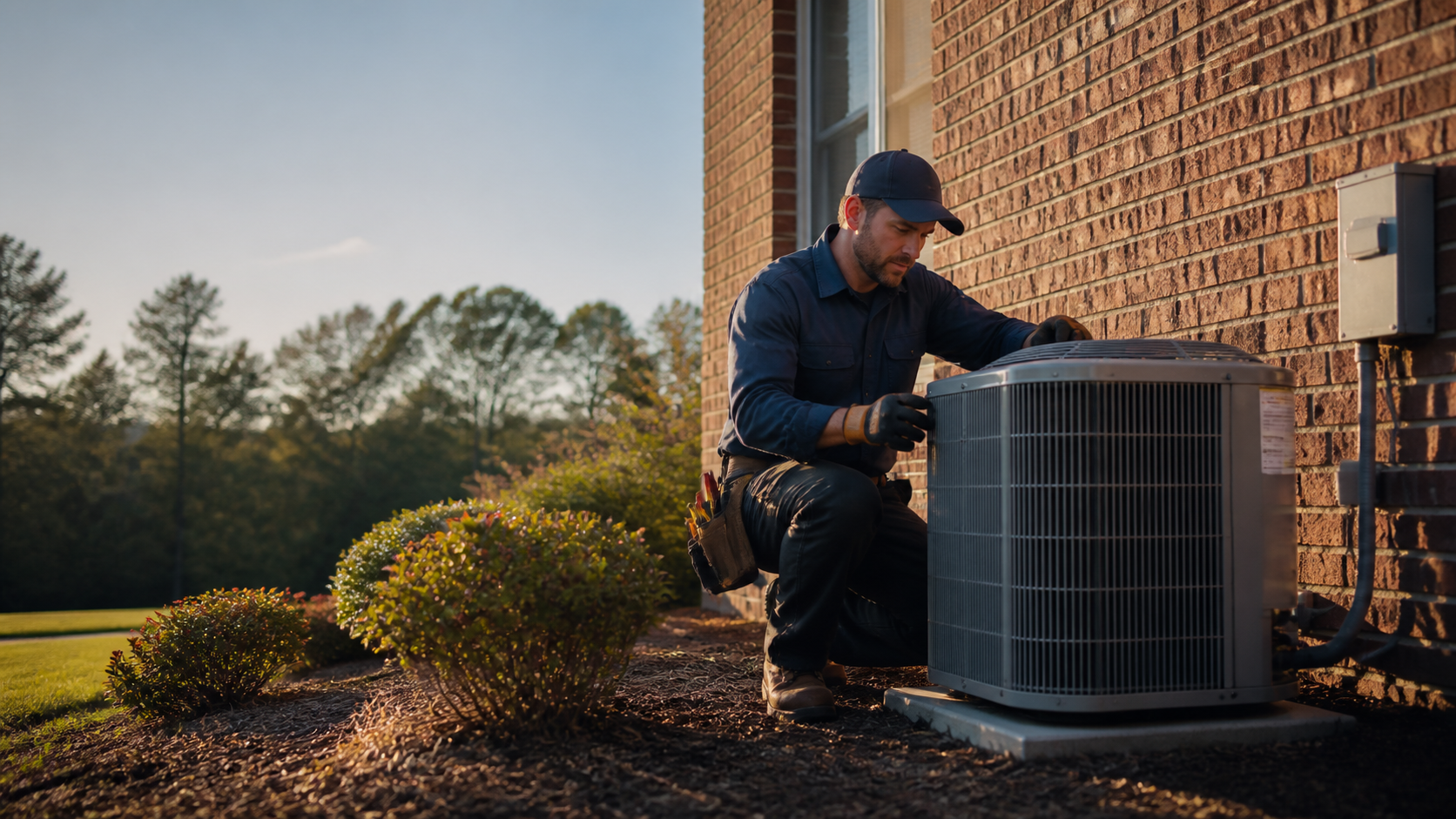
Listen safely
Put a name to the sound — grinding, buzzing, rattling, humming, hissing, clicking, screeching — and a location: the indoor air handler, the outdoor unit, the ducts, or the refrigerant lines.
Stop here
Switch the heat pump off for severe or constant noise, strong vibration, a fan that isn't turning, repeated clicking that never leads to startup, or a burning or electrical smell.
What to tell us
When the sound happens — startup, shutdown, defrost, heating, cooling, or nonstop — and what came along with it: ice, water, weak airflow, constant on-off cycling, or comfort that's gone.
Is a noisy heat pump always a repair problem?
No. The question that matters is whether the sound is familiar, brief, and attached to something the system does every day — or whether it marks a change from how your unit normally runs.
Plenty of heat pumps speak up at startup and shutdown. Variable-speed equipment shifts fan and compressor speed as demand moves, and its tone moves with it.
So compare today's noise against your own system's baseline rather than assuming every unfamiliar sound is either harmless or catastrophic.
Again, the defrost exception: a brief hum or whoosh in winter is routine. A quiet unit that turns loud, stays loud, or vibrates hard is the one that deserves a service call.
- Brief startup and shutdown sounds are usually normal.
- Variable-speed equipment changes pitch as demand changes.
- Defrost can bring a short hum or whoosh.
- New, louder, persistent, or shaking sound — that one gets looked at.
What can grinding, buzzing, and other sounds mean?
A sound tells you where to start looking, not which part died — no one can convict a component from the sidewalk. Grinding can involve the fan, a motor, the compressor, loose hardware, or another mechanical fault.
Grinding gets serious when the outdoor fan wobbles, the cabinet shakes, or the system stops heating and cooling properly.
Buzzing often traces to outdoor electrical controls, the fan motor, or the compressor area. A click followed by a hum that never becomes a real startup can point to the capacitor — the part that starts the motor — but that's a technician's test, not a homeowner's part swap.
Rattling usually means loose hardware or something touching a fan, though a blower wheel, motor, compressor, or an unlevel outdoor unit can all rattle too. A high-pitched whine outside can be loose hardware, the fan motor, the capacitor, or the compressor.
And hissing near the indoor coil or the refrigerant lines suggests a leak — which takes professional equipment to confirm and fix.
- Grinding or scraping with vibration points at something mechanical.
- Buzzing with no real startup needs electrical testing.
- Rattling: loose hardware, fan contact, or vibration transferring into the house.
- Hissing that persists alongside weak comfort or ice points at refrigerant.
What can I safely check before calling for heat pump repair?
Eyes and ears only. You're collecting information, not proving a failure.
Confirm the thermostat mode, notice whether the noise begins the moment the system gets the signal to heat or cool, and check the filter per the equipment instructions.
Walk the outdoor unit without opening anything. Leaves, twigs, snow, or shrubs crowding the airflow path all go in your notes.
If debris is visibly tangled in the fan area, don't reach through the grille after it. Pin down whether the sound is indoors, outside, or along the refrigerant lines, and if you can record a short phone video from a distance, do.
The hard boundary: don't open the cabinet, don't stop the fan with your hand, don't test a capacitor, don't adjust refrigerant, don't disconnect wiring, and don't reset a tripped breaker over and over. If the trouble involves the reversing valve — the component that flips the system between heating and cooling — the refrigerant circuit, the compressor, or a control board, describe the symptom and book the diagnosis.
- Confirm the thermostat mode and fan setting.
- Check the filter without disturbing anything else.
- Look for debris or blocked airflow around the outdoor unit.
- Record the sound and its timing from a safe distance.
- No open panels; no electrical or refrigerant work.
Can defrost mode make a heat pump sound different?
Yes — defrost has a whole soundtrack. In heating mode the outdoor coil runs colder than the air around it and collects frost, so the heat pump periodically melts it off: the reversing valve flips the refrigerant's direction, the outdoor coil warms up, and the frost lets go.
During that cycle the outdoor fan may stop entirely while the system hums a note deeper than usual or gives a different whoosh. A cloud of steam off the coil is normal too.
When the cycle ends, the sound should settle back to baseline.
But the word defrost doesn't explain away a genuinely loud unit. Call for service if the equipment stays sheathed in ice, keeps failing to clear the coil, stops heating, or keeps making a harsh sound after the cycle is long over.
- The outdoor fan may pause during defrost.
- A deeper hum, a whoosh, or a puff of steam can be normal.
- The sound should settle once the cycle ends.
- Persistent noise or persistent ice needs diagnosis.
When should I shut off a noisy heat pump?
Shut it down and arrange service when the sound is severe, constant, or riding along with a performance change — grinding with heavy vibration, a fan that isn't turning, repeated clicking that never becomes startup, hissing at the refrigerant lines, or any new noise arriving with lost heating or cooling.
Stop using the unit immediately if you smell burning rubber or an electrical odor from the outdoor equipment. And if a carbon monoxide alarm sounds, that ends the troubleshooting session entirely: get everyone outside to fresh air and call emergency services from there.
A noise report is strongest when you include what changed with it — weak airflow, warm air in heating mode, constant cycling, a blank thermostat, water, ice, a fan that won't spin, or a system that won't start at all.
- Off it goes for severe or constant mechanical noise.
- Stop for burning rubber, electrical odor, smoke, or sparking.
- Don't repeatedly reset a tripped breaker.
- CO alarm: leave and call emergency services from outside.
Should I repair or replace a noisy heat pump?
Noise alone doesn't settle that. Diagnosis comes first — a loose fastener, a debris problem, an electrical control, a fan motor, a capacitor, a refrigerant issue, and a compressor problem all make noise, and they lead to very different repairs.
The technician will weigh the equipment's age, maintenance history, how reliably it has kept the house comfortable, the scope of the repair, and the shape of the rest of the system. A newer heat pump with one serviceable fault is usually worth fixing.
An older one with repeat failures or a major sealed-system problem shifts the math toward comparing repair with replacement.
Before you decide, ask for the diagnosis: what failed, what the repair involves, and what evidence supports it. That's a whole-system decision — not a conclusion drawn from one noise.
- Loose hardware, debris, and many electrical faults argue for repair.
- Compressor or sealed-system trouble can change the answer.
- Age and repair history belong in the math.
- Ask what failed and what evidence backs the recommendation.
What should I tell a Frederick County HVAC technician?
Bring the sound in your own words: grinding, buzzing, rattling, humming, hissing, clicking, screeching. Add the location — indoor air handler, outdoor unit, ductwork, or the refrigerant lines.
Give it a clock: startup, shutdown, defrost, heating only, cooling only, or all the time. Then add whatever changed alongside — weak airflow, ice, water, a blank thermostat, constant on-off cycling, or comfort that quietly left.
A short, familiar defrost sound may pass on its own. A new grinding or buzzing sound should not be waved off — especially with vibration, fading comfort, or an electrical smell in the mix.
- The sound and where you hear it.
- When it starts and how long it lasts.
- Whether the system is heating and cooling normally.
- Any ice, water, weak airflow, constant cycling, or blank thermostat.
- What you safely observed at the filter and outdoor unit.
The sound itself is the headline
Name the noise — grinding, buzzing, rattling, humming, hissing, clicking, screeching — and place it: air handler, outdoor unit, ducts, or refrigerant lines. That pairing, in one sentence, is worth more to a technician than a folder of part theories.
Keep it at the top of your notes with the date it started, so the system's history stays anchored to what actually happened and when.
- One sentence: the sound, the place, the day it started.
Answers to the usual follow-up questions
Is a heat pump loud during defrost?
It can be, briefly. A whoosh, a deeper hum, a fan pause, or a steam cloud during defrost is normal operation. Loud grinding, scraping, banging, or a hot smell is not — that's a different problem wearing a defrost costume.
Should I turn off a noisy heat pump?
Yes, when the sound is severe, persistent, metallic, or electrical, when it comes with strong vibration or lost comfort, or when it's followed by a burning smell or a breaker trip. Brief familiar sounds during normal operation can wait.
Can a buzzing heat pump be a capacitor?
It can — the capacitor is the part that starts the motor, and when it weakens you often get buzzing or failed starts. But contactors, motors, and compressors buzz too. A technician tests before replacing anything, so you're not paying for a guess.
Can a heat pump noise mean low refrigerant?
It can. Persistent hissing or bubbling points that direction, especially with weak comfort or ice in the picture. Confirming it takes professional equipment and handling — refrigerant isn't a DIY substance.
What should I record before service?
The sound, where it happens, when it starts, how long it lasts, whether the system is heating or cooling normally, and whether ice, water, a breaker trip, or a smell showed up alongside.