24-Hour HVAC Repair in Frederick
What to Do When Your System Fails After Hours
When the heat quits at 11 p.m., or the AC dies on a July night, the first question isn't always who to call — it's whether anyone is in danger. A Frederick County winter outage, a summer heat wave, and a storm that takes out power each change the answer.
So work the problem in order: confirm the house is safe, make the few checks that need no tools, write down what changed, and leave the diagnosing to a pro. A breakdown at midnight doesn't mean the system is finished, either — plenty of overnight problems turn out to be small.
That order keeps the people in the house first and the equipment second. Then you can decide whether this needs a truck tonight or can hold until morning.
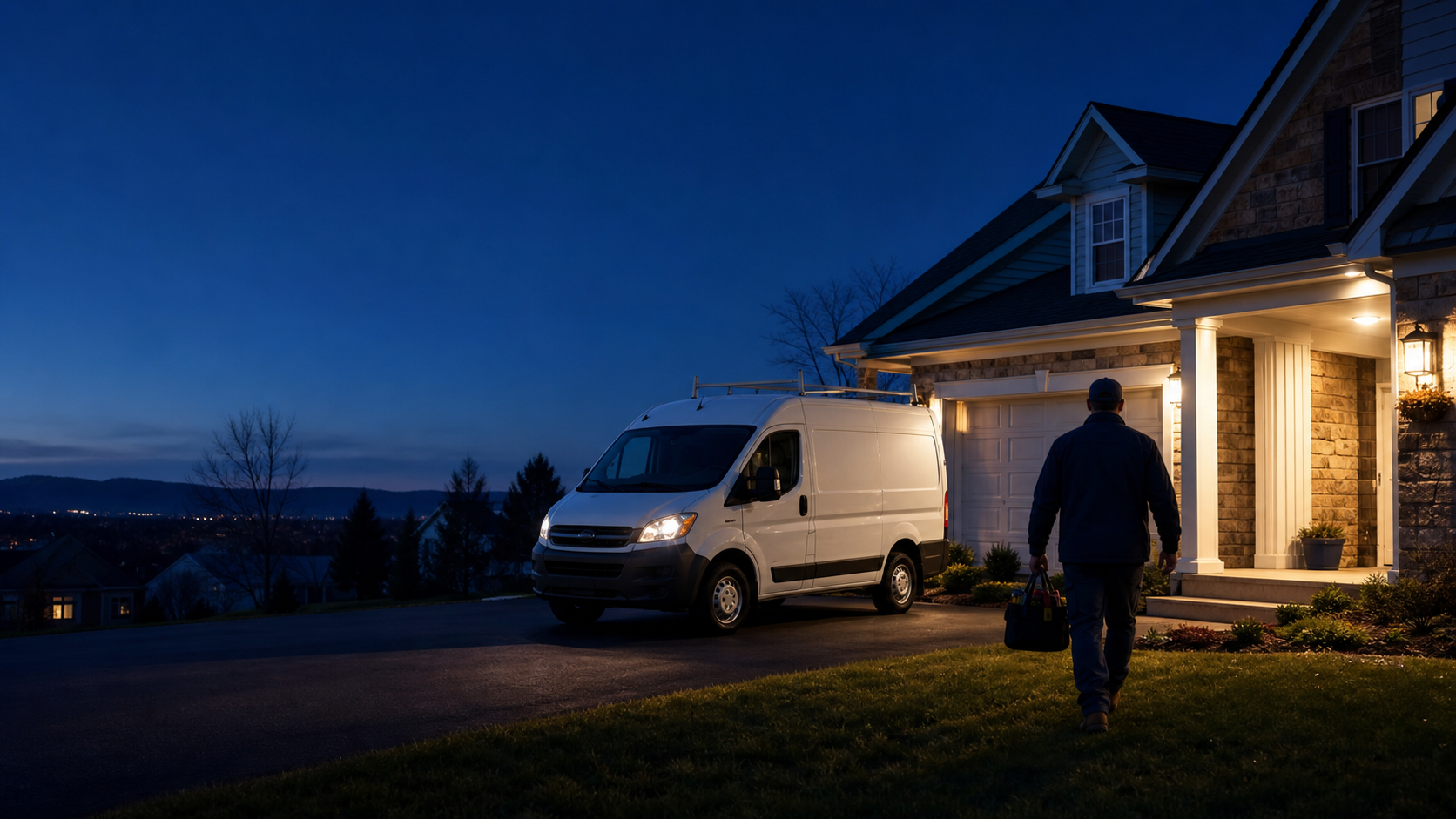
Leave first
Gas smell, smoke, fire, arcing, damaged wiring, or a CO alarm: get outside and call 911 from a safe spot. Troubleshooting comes after the people are clear.
Look, don't open
If the house is safe, glance at the thermostat, the breaker, the filter, and the vents, and note any water or ice in sight. Stop the moment a check needs a screwdriver.
Bring useful details
The system type, the exact symptom, when it started, any storm or outage just before it, what the thermostat shows, and whether the indoor or outdoor unit is running.
Safety comes before the thermostat
Get out and call 911 from a safe place if you smell gas (the rotten-egg odorant is hard to miss), see smoke or fire, hear arcing, or find wiring that's visibly damaged. Don't touch light switches, start a car in the garage, or use a phone inside the area where you smell gas — any of those can make a spark.
Take a CO alarm seriously. Carbon monoxide has no smell and no color.
If the alarm sounds, or anyone home develops a headache, unusual tiredness, shortness of breath, nausea, or dizziness, get everyone to fresh air and call 911 from outside.
Don't improvise heat overnight. A gas oven, range, or dryer is not a heater, and neither is a charcoal grill or a generator.
If you run an electric space heater for a few hours, keep it three feet from anything that burns, plug it straight into the wall, and turn it off when you leave the room or go to sleep.
- Gas smell, smoke, fire, arcing, or damaged wiring: out of the house first, then 911.
- A CO alarm, or symptoms that ease once you're outdoors: fresh air, then 911 from outside.
- No ovens, ranges, dryers, grills, or generators used as heaters.
- Electric space heater only: three feet of clearance, wall outlet, off when you leave the room or sleep.
The checks that are safe at midnight
With no gas smell, no CO alarm, and no smoke, you can make a handful of low-risk checks. The line is simple: if a check means pulling a panel, touching wiring, or getting near the burner or the refrigerant lines, it's off the table.
Look at the thermostat first. Is the display lit?
Is the mode set to heat or cool as needed, with a setting above or below the room? A blank display deserves a note of its own — that usually points to power or a control problem, not a setting.
Check the HVAC breaker only if the panel is dry, easy to reach, and undamaged. Reset it once if it has tripped.
If it trips again, leave it off and arrange help — especially with a burning smell, water nearby, buzzing, or visible damage. A repeat trip is the system telling you something is shorting.
Then the airflow pieces: the filter, the supply registers, the return grille. Swap the filter only if you have the right size on hand and can reach it without opening the equipment.
Move whatever is blocking vents — furniture, rugs, boxes, curtains.
Finally, look for water, ice, or a soggy drain area around the equipment. Watch, don't touch: no chipping ice off a coil, no opening cabinets.
These checks can surface a setting, filter, airflow, or power clue. They can't confirm a failed capacitor, motor, control board, heat exchanger, compressor, or gas component — that takes a tech and a meter.
- Thermostat: display, mode, setpoint — write down exactly what it shows.
- Breaker: one reset if the panel is dry and undamaged; leave it off if it trips twice.
- Filter: swap only if you have the right size and can reach it safely.
- Registers and returns: clear the blockers and note which rooms behave differently.
- Water or ice: observe it without opening the equipment or chipping the coil.
The equipment changes the clues
A furnace, a heat pump, and an air conditioner don't fail the same way, so what you report depends on what you own. Tell us which system you have and whether the problem is heat, cooling, airflow, or the thermostat.
For a furnace: does it run without warming the air, start and stop over and over, or never start at all? Note whether the thermostat is set to HEAT and asking for warmth, whether the blower runs, and whether the trouble began after a power interruption.
And don't treat a furnace that ignores its thermostat as proof that one specific part died — that takes testing.
A heat pump moves heat between the house and the outdoor air, so the mode and the outdoor temperature both matter. Describe what the outdoor unit is doing and whether the indoor fan is moving air.
For central AC, warm registers, a frozen line outside, water at the indoor unit, or a system that starts and stops every few minutes (short cycling) are all useful observations — observations, not a diagnosis by phone.
- Furnace: set to HEAT? Blower running? Starting and stopping repeatedly?
- Heat pump: mode, outdoor temperature, and what the outdoor unit is doing.
- AC: warm air, ice, water, short cycling, or silence.
- Never open a sealed system or attempt refrigerant work.
What to have ready when you call
Write the details down while they're fresh. You don't have to know which part quit — a clear description of what changed is worth more, and it can save a second trip for missing information or parts.
When you reach a technician, ask for plain language: What failed? Is the system safe to run?
What repair is on the table, and what caused it? Is there a stopgap that protects the house tonight?
If the equipment is old or the repair is big, ask what points toward repair and what points toward replacing. A clear explanation beats a rushed guess made in the dark.
- Equipment type: furnace, heat pump, central AC, ductless, or other.
- The exact symptom: no start, no heat, no cooling, weak airflow, water, ice, noise, odor, repeated cycling.
- When it began, and what happened just before — storm, outage, filter change, thermostat swap.
- What the thermostat displays; whether the indoor blower and outdoor unit run.
- Visible water, ice, soot, scorch marks, damaged wiring, or a blocked outdoor vent.
- Model and serial numbers if they're readable without opening anything; any past repairs or repeat failures.
Fix tonight, decide the rest tomorrow
An overnight failure doesn't put replacement on the table by itself. Separate the urgent piece — making the house safe and livable — from the longer-term decision.
A modest repair may buy years while you gather information.
Age alone doesn't decide it, either. Ask whether the repair addresses the actual cause, whether this same symptom has come back before, how the system performs across the whole house, and whether it's the right size and moving air the way it should.
And don't sign for a full replacement just because the breakdown happened after hours. Get the diagnosis, understand any safety issue, and compare the repair against a planned replacement once the household is out of crisis mode.
- Stabilize the safety or comfort problem first.
- Ask what failed, what caused it, and whether it has happened before.
- Weigh the whole system: condition, sizing, airflow, repair history.
- Replacement is a daytime decision, not a midnight guess.
Heading off the next 2 a.m. call
A few habits make the next problem easier to catch. Check the filter monthly during heavy heating and cooling seasons, book a pre-season checkup once a year, and keep the area around heating equipment clear of combustibles.
Test CO alarms monthly, keep one on every level and outside the bedrooms, and replace them on the manufacturer's schedule. After snow or a severe storm, confirm the furnace, stove, fireplace, and dryer vents aren't buried.
A generator never runs indoors, in a garage, or near doors, windows, or vents.
Keep a note in your phone with the equipment type, model number, filter size, and the date of the last service visit. If you ever lose heating or cooling after hours in Frederick, that note plus your observations gives the diagnosis a running start.
- Filter check monthly in heavy season; one pre-season tune-up a year.
- Three feet of clearance around heating equipment.
- CO alarms tested monthly, with one near the sleeping areas.
- Vents cleared after snow; generators stay outside, always.
- Equipment type, model, filter size, and last service date — saved in your phone.
If it's dangerous, that's the whole plan
Gas smell, smoke, fire, arcing, or a CO alarm: get everyone outside and call 911 from a safe spot. Nothing else in this guide comes before that.
The service history can wait for daylight. What matters tonight is that everyone is out and the utility or fire department is on the way.
- Leave first, call 911 from outside, and sort the HVAC side once the danger is cleared.
If it's just the equipment acting up
Thermostat, breaker, filter, registers, and anything visible without tools — that's the complete list of midnight checks. The moment one of them needs a panel off or a wire touched, stop.
Jot down what you found before you forget it. Those notes carry straight into the diagnosis, tonight or in the morning.
- Look at what's visible, write it down, and leave the tools in the drawer.
Answers to the usual follow-up questions
What counts as a 24-hour HVAC emergency in Frederick?
A gas smell or a CO alarm, no question: leave the house and call from outside. Smoke, a burning smell, spreading water, or a breaker that keeps tripping belong on that list too, along with heat or cold that threatens infants, older adults, or anyone medically fragile. Most everything else can wait for daylight.
What counts as a 24-hour HVAC emergency in Frederick?What can I safely check before calling for after-hours repair?
If there's no hazard: the thermostat display and setting, the HVAC breaker (only if the panel is dry and undamaged), the filter, blocked registers or returns, and any water or ice in sight. Stop at anything that needs the equipment opened, wiring touched, or refrigerant handled.
What can I safely check before calling for after-hours repair?Should I call at night or wait until morning?
Call now if anyone is at risk or there's a safety issue. If the house is safe and tolerable, morning service usually costs less and gives you more room to understand the repair before approving anything.
Does after-hours HVAC repair cost more?
Often, yes — but ask instead of assuming. Before booking, get how the after-hours visit is priced, whether there's a separate diagnostic fee, and whether that fee credits toward a repair. Have the terms clear before the truck rolls.
Does after-hours HVAC repair cost more?What should I tell the HVAC technician?
The equipment type, the exact symptom, when it started and what happened just before, what the thermostat displays, whether the indoor blower or outdoor unit runs, and anything visible — water, ice, soot, scorch marks, damaged wiring, a blocked vent. Skip the part-name guesses.
Should I agree to a full system replacement overnight?
Be careful. An emergency repair stabilizes the house; a full replacement is a daytime decision made with a diagnosis and written quotes, not something to sign at midnight before anyone has tested the system. Once the immediate problem is handled, ask what supports repair and what supports replacing.