Heat Pump vs. Furnace and AC: Which System Fits?
If you're comparing a heat pump with a furnace and central air conditioner, you're probably trying to make a decision under pressure. The old system may be aging, repairs may be adding up, or one part of the house may never feel comfortable. The right answer isn't the same for every Frederick County home.
A heat pump handles heating and cooling in one system by moving heat. A furnace and AC split those jobs between two appliances. The useful question is which system matches the home's heating and cooling loads, ductwork, insulation, electrical service, fuel options, comfort priorities, and winter plan.
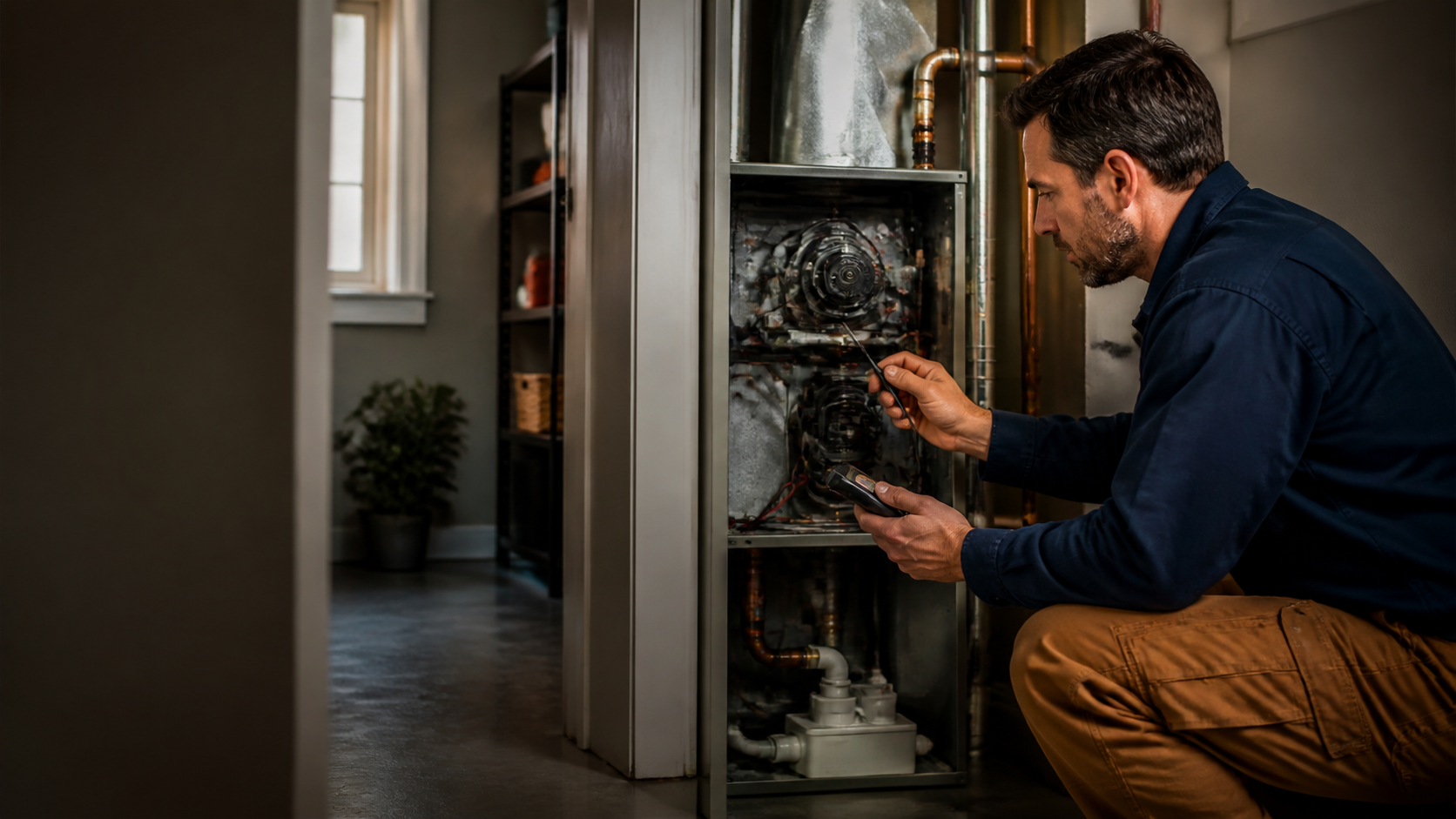
How the two system choices differ
| Decision point | Heat pump | Furnace and AC |
|---|---|---|
| Heating and cooling | One outdoor system reverses operation | A furnace heats and an AC handles cooling |
| How heat is made | Transfers heat with electricity | Furnace creates heat through combustion or electric resistance |
| Existing ductwork | Still needs ducts in a ducted design | Uses the same duct and return design |
| Cold-weather plan | Proposal explains capacity and backup heat | Furnace is the dedicated heating source |
| Controls | Thermostat coordinates heating, cooling, and backup | Controls switch between separate appliances |
| Replacement scope | May include outdoor, indoor, controls, and backup changes | May replace one or both appliances and related components |
How a heat pump differs from a furnace and AC
An air-source heat pump uses electricity to transfer heat rather than create heat through combustion. In summer, it moves heat out of the house. In winter, it moves heat from outdoor air into the house. The same outdoor unit can provide cooling and heating, which makes it a year-round system. The U.S. Department of Energy explains how heat pumps transfer heat in both seasons.
A furnace heats air and sends it through the ductwork. A central AC removes heat from indoor air during the cooling season. A furnace-and-AC arrangement separates those jobs, while a dual-fuel system combines a heat pump with a furnace so the home has two heating options. ENERGY STAR describes a ducted air-source heat pump as a central air conditioner that also works in reverse for winter heating.
- A heat pump can heat and cool; a standard central AC only cools.
- A furnace-and-AC arrangement may fit a home whose existing equipment and duct design are healthy.
- A dual-fuel system adds a changeover decision between the heat pump and furnace.
- Neither option is automatically better. Both need correct sizing, matched components, usable distribution, and careful installation.
Which setup can fit a Frederick County home?
A heat pump may fit when the home has serviceable ductwork and the homeowner wants one system for both seasons. The indoor coil, blower, thermostat, electrical supply, duct capacity, outdoor unit, and home envelope still need to work together. ENERGY STAR buying guidance explains when a ducted heat pump may use existing ductwork.
Keeping a furnace and central AC can be sensible when the equipment is in good condition, the ductwork delivers even comfort, and the home's fuel and operating priorities support that arrangement. If the current system performs well, changing both appliances simply to adopt a different technology may not be necessary.
Dual fuel is worth discussing when your home already has a furnace and you want a heat pump's heating and cooling range plus a second heating option. The changeover point depends on equipment controls, outdoor conditions, utility costs, and system design. Maryland Energy Administration guidance covers replacement and supplemental heat-pump configurations.
- The system choice should follow the house and its current condition, not a technology label alone.
- A ducted heat pump still needs suitable airflow, returns, transitions, and service access.
- Dual fuel is a design strategy, not a promise that one heat source will always cost less.
Can a heat pump handle a Frederick County winter?
Yes, a properly selected heat pump can be part of a Frederick County heating plan. Cold-climate models are designed for lower outdoor temperatures, but a label alone doesn't tell you whether a particular model, capacity, duct system, and home envelope will maintain comfort. ENERGY STAR describes cold-climate models and dual fuel as options for lower-temperature flexibility.
Ask us how the proposed system handles your home's coldest design conditions, whether backup heat is included, and how the controls choose between heat sources. Those are equipment and installation questions, not reasons to assume every heat pump performs the same way.
- The proposal should show capacity at relevant outdoor conditions.
- Backup heat and its operating controls should be explained before installation.
- The winter plan should account for the home's load, ductwork, insulation, and electrical service.
What home conditions determine the fit?
Start with the heating and cooling loads. Proper sizing begins with accurate calculations for both loads, and Manual J is a useful way to verify the home's requirements. DOE Building Science Education explains the sizing questions behind a cold-climate heat-pump design. Oversizing isn't a harmless safety margin: a system that's too large can cycle too often, waste energy, and create comfort problems.
Ducts, supply registers, return paths, and the blower need to move the air the selected system requires, and a swing wider than 5 or 6 degrees room to room is a sign something's off. Poorly sized or poorly placed registers can contribute to drafts, stagnant air, and noise even when the equipment itself is high quality. DOE guidance connects duct terminal sizing with airflow and comfort.
Also look at the home envelope. Air leakage and inadequate insulation can make a properly operating HVAC system struggle to hold a steady temperature. If one bedroom is always cold, the top floor overheats, or the system runs far longer than expected, the cause may involve ducts, insulation, windows, or air sealing. DOE weatherization guidance includes air sealing and insulation as whole-home considerations.
- Bring model numbers if easy to find, the approximate installation year, repair history, and utility information.
- Note which rooms are uncomfortable, when the problem happens, and what the thermostat is doing.
- Do not approve a size based only on the old equipment's label or the biggest available model.
Should you repair the existing system or replace it?
Don't let an equipment comparison turn a repairable problem into an automatic replacement. A no-start condition, weak airflow, warm air, short cycling, ice, water, or unusual noise needs a diagnosis from us before we know whether a different system type is actually necessary.
Replacement planning becomes more reasonable when several conditions point in the same direction. ENERGY STAR lists a heat pump or air conditioner over 10 years old and a furnace over 15 years old as reasons to consider replacement planning, along with frequent repairs, rising energy bills, and rooms that stay too hot or too cold. Use that guidance as a planning reference, not as a fixed expiration date.
The repair-versus-replace conversation should include how the current equipment is holding up, the risk of the next repair, ductwork, comfort history, and whether the proposed replacement solves the original problem. Restricted ducts or poor insulation can leave uneven temperatures after an equipment change.
- For a heat pump, ask about cold-weather capacity, backup heat, electrical requirements, controls, and service access.
- For a furnace and AC, ask whether components are matched and whether furnace venting is safe.
- For any option, ask how the size was calculated and what problem the proposed work is meant to solve.
What should a replacement proposal explain?
Ask us for the load calculation, equipment sizes, duct or airflow findings, thermostat and control plan, electrical and fuel requirements, drain work, and commissioning checks. For a furnace and AC pair, ask whether both pieces need replacement or one can safely stay in a matched setup. For a heat pump, ask what backup heat runs and how the thermostat manages it.
Keep rebates, operating-cost estimates, and warranty terms separate from the equipment comparison until current programs and manufacturer requirements are verified for the selected system. A sound decision still works if outside incentives change. New HVAC system planning should leave you with a clear scope and a reason for each major component.
- Require a written explanation of what stays, what changes, and why.
- Compare comfort, controls, maintenance, and service access along with the initial project scope.
- Make sure the proposal accounts for the duct transitions, indoor equipment, drain work, and electrical or fuel work it needs.
When is the comparison a safety issue?
Stop comparing equipment and leave the home if a carbon monoxide alarm sounds or you suspect a dangerous combustion problem. Carbon monoxide can't be seen, smelled, or tasted, and fuel-burning appliances such as furnaces can be involved in CO poisoning. Read the Consumer Product Safety Commission's carbon monoxide safety guidance.
Do not open combustion equipment, bypass a safety control, work on live electrical parts, or handle refrigerant because you are trying to decide between a heat pump and a furnace. Leave gas odors, burning electrical smells, smoke, repeated breaker trips, and CO alarms to the appropriate emergency or utility response first. HVAC selection can wait until the home and occupants are safe.
- Leave immediately for gas odor, smoke, fire, sparking, or a carbon monoxide alarm.
- Call 911 or the gas utility from a safe location when the situation requires it.
- Arrange professional inspection of fuel-burning heating systems and their vents.
Questions that come up next
Is a heat pump better than a furnace and AC?
It depends on your home's load, ductwork, fuel and electrical setup, comfort priorities, and backup plan. A heat pump combines heating and cooling in one system; a furnace and AC pair keeps those jobs separate. We start the comparison with your house, not a blanket claim about one technology.
Can a heat pump use my existing furnace ducts?
A ducted heat pump can use existing ducts when the airflow, returns, transitions, and sizing all check out. The ducts still need inspection, and any repairs or changes should be explained before the new system is approved.
Can a heat pump handle a Frederick County winter?
A properly selected heat pump can be part of a Frederick County heating plan. The proposal should show capacity at relevant outdoor conditions, whether backup heat is included, and how the controls change between heat-pump and backup modes.
Should I replace a furnace and AC that still work?
Not automatically. If the equipment is healthy and the home is comfortable, replacement may not be necessary just to change technology. Diagnosis, equipment condition, repair history, ductwork, comfort problems, and the proposed system's design should guide the decision.
What should a heat pump proposal explain about cold weather?
It should show the system's capacity at relevant outdoor conditions, when backup heat operates, and how the controls choose between heat-pump and backup modes. If those details are missing, the comfort plan is incomplete.
Need HVAC help in Frederick?
Tell us what the system is doing and what you've checked already. If it needs a visit, we'll say so.