Why Is My Heat Pump Running but Not Heating?
If your heat pump's running but your Frederick County home is still cold, the cause might be as simple as a thermostat or airflow problem. Or it might need diagnosis from us. Heat pumps move heat from outdoor air into the home, so their air often feels cooler than furnace air. The useful question is whether the indoor temperature's steadily rising, whether the outdoor unit's operating normally, and whether a visible warning sign points to a fault.
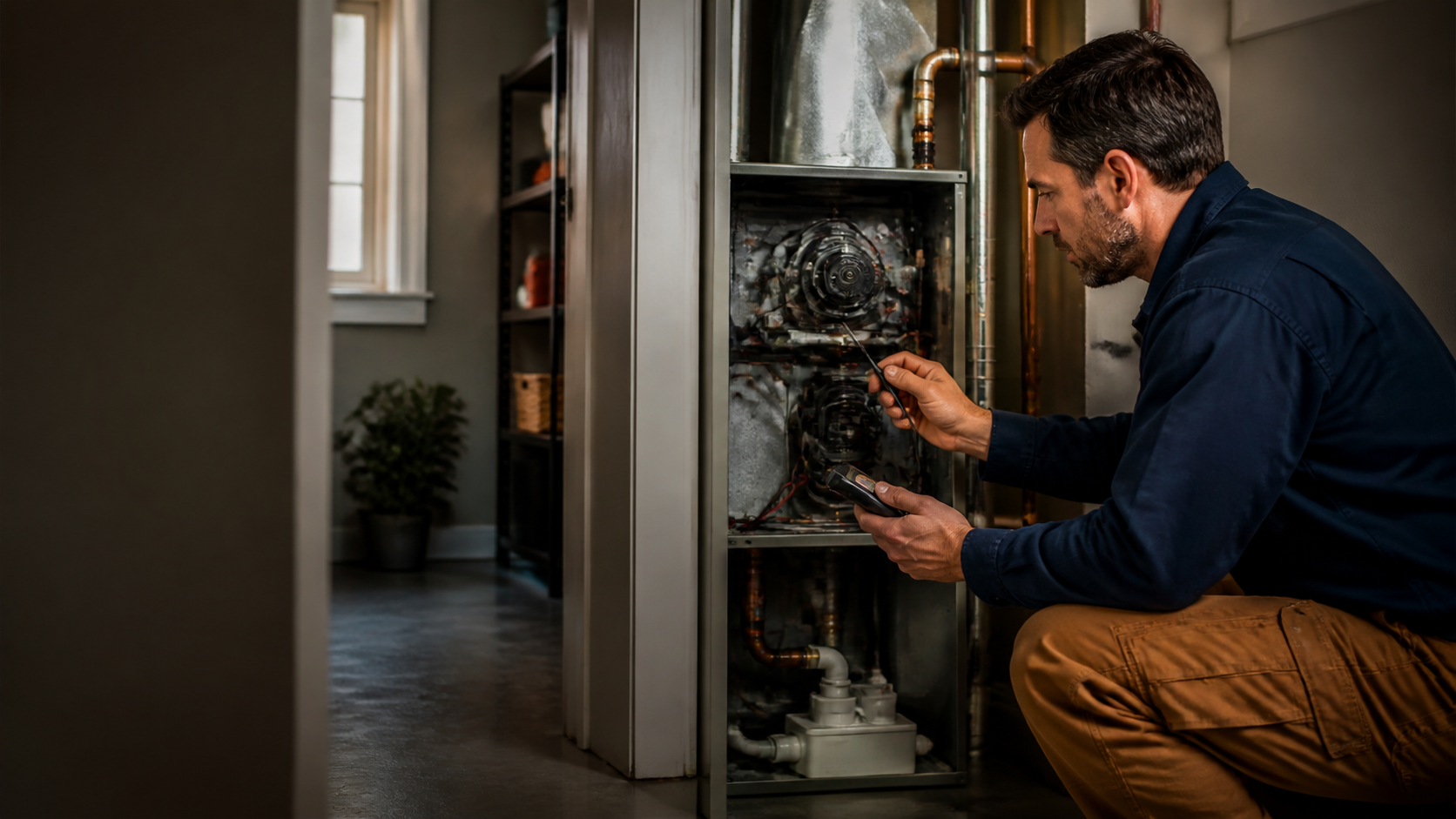
Why a heat pump can run without heating
| Possible cause | What you might notice | What we check |
|---|---|---|
| Thermostat or control issue | The system is in the wrong mode, has the wrong fan setting, or is not holding the call | Mode, setpoint, fan operation, and the control sequence |
| Restricted airflow | Weak supply air, long runtimes, or a dirty filter | Filter, returns, registers, blower operation, and temperature change |
| Defrost problem | The outdoor coil stays heavily iced instead of clearing | Defrost sensor, board, coil condition, and refrigerant-side clues |
| Low refrigerant from a leak | Weak heat, long runtimes, unusual ice, or a system that cools but will not heat | Pressures, temperatures, leak evidence, and charge condition |
| Reversing-valve, compressor, or electrical fault | The outdoor unit runs but the air stays cool or the system cannot change modes | Valve operation, compressor performance, and electrical readings |
Why heat-pump air can feel cooler than furnace air
A furnace usually sends a short burst of very hot air into the ductwork. An air-source heat pump generally supplies a steadier stream of warm air because it moves heat from outdoor air instead of creating heat the way a furnace does. Air that feels lukewarm against your hand isn't automatically a failure if the room temperature holds or rises. The Department of Energy explains how that heat transfer works.
Watch the temperature and the pattern. A brief cooler spell can happen during defrost, when the system melts frost off the outdoor coil. A typical cycle runs 5 to 15 minutes. Air that stays cold, a home that keeps losing heat, or an outdoor unit that never clears is a different problem, and it's one we should look at.
- Steady warm air and a stable or rising room temperature can be normal heat-pump operation.
- A fan set to On can move air when the system isn't actively heating; use Auto for the normal check.
- Cold, damp weather can make an air-source heat pump work harder because outdoor air's its winter heat source.
What's safe to check before you call
Start with the thermostat set to HEAT, a setpoint above the room temperature, and the fan on Auto. Check the filter. Open supply registers, and make sure return grilles aren't covered by furniture, rugs, or curtains. Look at the outdoor unit from a safe distance and clear loose leaves or snow around the cabinet. Don't scrape ice from the coil or pour hot water over it.
Check the electrical panel for a tripped heat-pump breaker only if there's no burning smell or visible damage. If it trips again, leave it off and call us. Don't add refrigerant, disconnect lines, bypass a control, or open an electrical cabinet. The EPA explains why refrigerant service needs qualified handling.
- Confirm the mode, setpoint, fan setting, filter, registers, returns, and outdoor clearance.
- Write down what the thermostat displays and whether the symptom changes with weather or defrost.
- Stop at ice, water, unusual noise, a repeated breaker trip, or any electrical or refrigerant work.
What frost and ice on the outdoor unit can mean
Light frost can form on an outdoor coil in cold, damp weather, and a working defrost cycle should clear it. Thick ice, ice that returns quickly, a fan that can't move air, or a unit stuck in defrost can point to restricted airflow, a defrost fault, low refrigerant, or another equipment problem. The Department of Energy homeowner guide describes this defrost behavior.
Keep the outdoor unit open to airflow. Don't cover it for winter storage, chip at the coil, or pour hot water over the ice. Protect it from roof runoff and heavy snow with the arrangement your home and equipment call for.
- Brief frost that clears during defrost is different from a coil that stays covered.
- Persistent ice or a system stuck in defrost needs us to take a look.
- Keep leaves, snow, weeds, and other loose debris away from the outdoor cabinet.
When a running heat pump needs professional diagnosis
Call us for heat pump repair in Frederick when the basic checks don't restore heating, or sooner if the indoor temperature keeps dropping, the system blows cold air continuously, the outdoor unit's heavily iced, a breaker trips repeatedly, airflow stays weak, or the thermostat shows an error. New hissing, grinding, or other unusual equipment sounds deserve attention too.
The same complaint can come from different parts. We test controls, airflow, electrical operation, the refrigerant circuit, defrost, and mode changes. If the heat pump cools but won't switch into heating, refrigerant or reversing-valve trouble might be involved. That diagnosis separates a repairable fault from a bigger equipment decision. Carrier identifies refrigerant and electrical issues that require a trained technician to fix.
- Persistent cool air or a falling indoor temperature isn't a wait-and-see symptom.
- Don't treat emergency heat as the repair; use it only as the equipment instructions direct.
- Ask us what failed, what the repair addresses, and whether repair or replacement makes sense for older equipment.
Questions that come up next
Can a heat pump blow cool air during normal operation?
A brief spell of cooler air can happen during a defrost cycle, and heat-pump air generally feels less hot than furnace air. If the temperature keeps falling, the air's cold continuously, or heavy ice won't clear, call us for a diagnosis.
Can I add refrigerant to a heat pump myself?
No. Refrigerant work needs the right tools and training, and a low charge usually means the system needs leak and performance testing, not an unexplained top-off.
Should I switch to emergency heat when the heat pump won't heat?
Emergency heat is a supplemental source for some systems, not a fix for the heat pump. Follow the thermostat and equipment instructions while you call us, and tell us whether the home's losing heat or the outdoor unit's iced.
How long should a heat-pump defrost cycle last?
A typical defrost cycle runs 5 to 15 minutes. If the system stays in defrost, stays covered in ice, or the home keeps losing heat, call us instead of waiting it out.
Need HVAC help in Frederick?
Tell us what the system is doing and what you've checked already. If it needs a visit, we'll say so.