How Do You Hard Reset a Heat Pump?
If your heat pump has stopped responding, a controlled power reset may bring the controls back online. Set the thermostat to Off, turn off the heat pump at its dedicated breaker or disconnect switch, wait about 5 minutes, restore power, and return the thermostat to Heat or Cool. Carrier gives this sequence for a heat pump reset.
That procedure is for a system that needs a restart. It isn't a repair for a tripped breaker, burning smell, exposed wiring, heavy ice, or a mechanical problem. If the breaker's tripped, or trips again after power's restored, stop resetting it and call us.
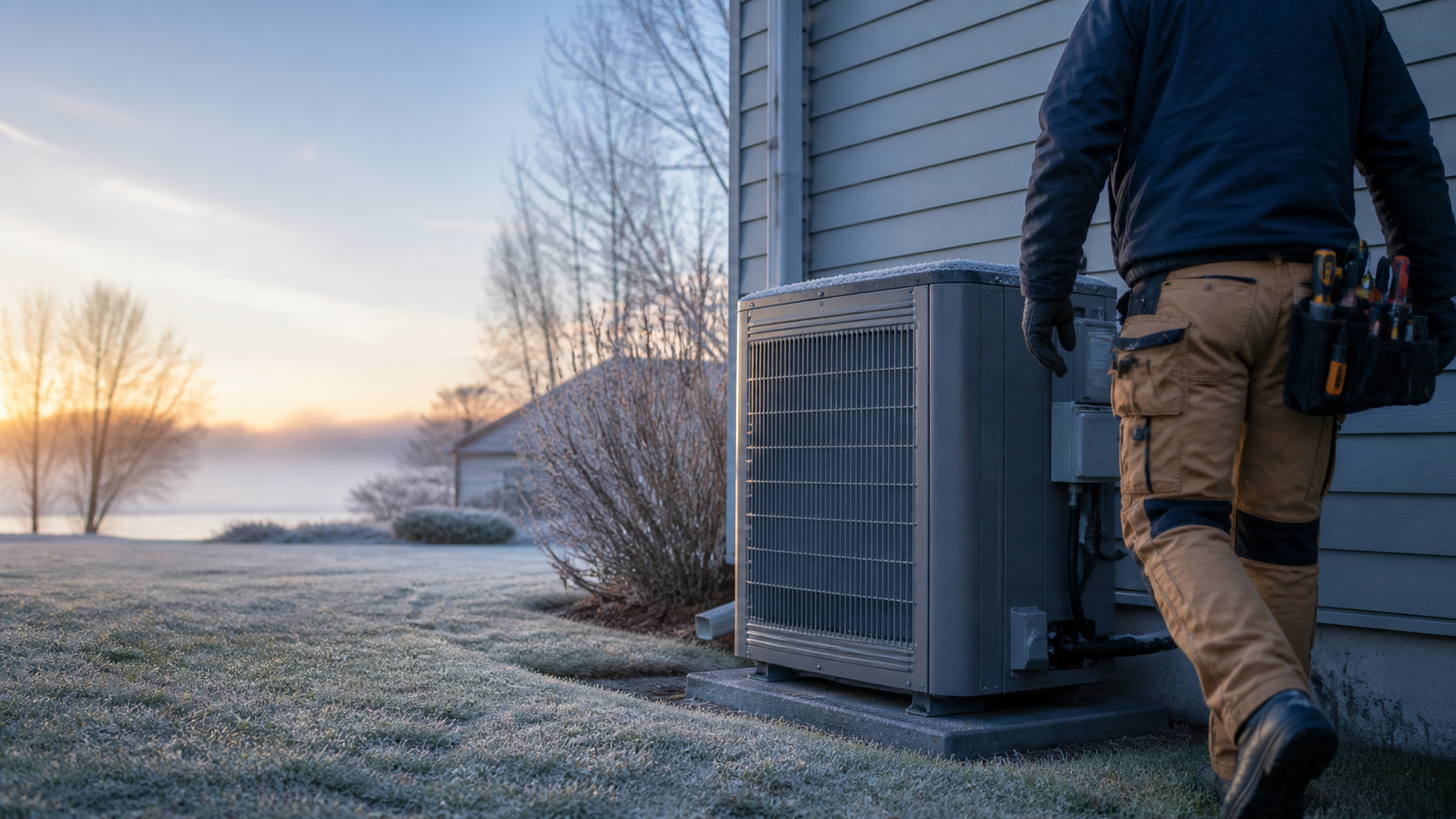
When a heat-pump reset is and is not appropriate
| Situation | Homeowner action | Why |
|---|---|---|
| The system stopped after a power blip and no hazard is present | Try one cautious power cycle | A control may need a clean restart |
| The breaker has tripped or trips again | Leave it off and call for diagnosis | A repeat trip can point to an electrical or equipment fault |
| There is a burning smell, smoke, or exposed wiring | Do not restore power; request appropriate emergency help | The equipment may present a fire or electrical hazard |
| Water is near the air handler or electrical equipment | Keep clear and address the electrical hazard | Moisture and electricity are unsafe together |
| Ice covers the outdoor unit | Do not chip the ice or force the system to run | The cause may involve airflow, refrigerant, controls, or defrost operation |
How to hard reset a heat pump safely
Before you start, check for burning smells, smoke, exposed wiring, water near electrical equipment, or unusually loud noise. Don't remove an equipment panel. See a warning sign? Leave the system off and call us.
Use this sequence only with a clearly identified power control you can reach safely. Depending on the installation, the heat pump may have a circuit breaker or a disconnect switch near the outdoor unit, and some systems have a separate power switch for the indoor air handler.
- Set the thermostat to Off so it isn't calling for heating or cooling while power's interrupted.
- Turn the equipment power off at the clearly identified breaker or disconnect. Don't open the cabinet or handle wiring.
- Leave power off for about 5 minutes so the controls complete the interruption instead of restarting right away.
- Restore power, wait a few minutes, and set the thermostat to Heat or Cool at a reasonable temperature.
- Watch and listen for normal operation. If the same symptom returns, don't repeat the reset.
What to check before you reset the system
A heat pump that seems frozen may be getting the wrong command or may not have enough airflow. Confirm the thermostat mode matches what you need, and check the fan setting. A fan set to On can move room-temperature air even when the heat pump isn't actively heating. ENERGY STAR advises using an explicit heat or cool mode instead of Auto during unusual weather.
Look at the thermostat display. A blank screen can mean dead batteries, a tripped HVAC breaker, or a system power switch that's off. Replace accessible batteries if needed. Don't pull a wired thermostat off the wall or change its wiring as part of a reset.
Inspect the air filter and swap a disposable one for the size and type your system needs. Clean a reusable filter per the manufacturer's instructions. A clogged filter can restrict airflow and make the system run longer, or shut down on an internal safety control.
- Clear loose debris near the outdoor unit and keep indoor return vents and supply registers open.
- Look at the outdoor unit without opening it. Don't chip ice off the coil, pour hot water on it, or reach through the grille.
- If the equipment manual gives a different reset sequence, follow the instructions for your model.
What if the heat-pump breaker has tripped?
Treat a tripped breaker differently from a planned reset. A breaker may sit in the Off position or in a middle position between On and Off. ESFI explains how to recognize a tripped breaker.
Not sure whether a switch belongs to the heat pump? Don't guess. Don't hold a breaker in place, swap it for a larger breaker, remove the panel cover, or reset the same breaker again and again.
Trane warns that a tripped heat-pump breaker may point to a problem that caused the trip. If it trips again, won't stay on, or makes a buzzing or sizzling sound, leave it off and call us or a qualified electrician, whichever fits.
- One controlled reset is a troubleshooting step; repeated breaker resets aren't a repair.
- Don't test the breaker again just to see whether the next reset works.
- Tell us whether the breaker tripped once or immediately tripped again.
How long should a heat pump take to restart?
Don't judge the reset by whether warm or cool air comes out instantly. After power returns, the thermostat has to call for the selected mode, and the equipment may follow its normal startup delay. Give it a few minutes, then check whether the indoor fan and outdoor unit behave normally.
Cold air for a short period during heating doesn't always mean the heat pump failed. A heat pump can enter defrost mode to melt ice from the outdoor unit. Constant cold air, a heavily iced outdoor coil, or a system that never returns to normal operation needs a closer look. Carrier explains this defrost behavior in its heat-pump troubleshooting guidance.
- A reset that restores operation but leaves the original symptom in place hasn't solved anything.
- Note whether the indoor fan runs, whether the outdoor unit starts, and whether the home reaches the thermostat setting.
- Share the timing and the symptom with us instead of trying another reset.
Why a reset may not fix the heat pump
A reset clears a power or control interruption. It can't repair a damaged component, wiring problem, refrigerant issue, or hidden restriction. If the outdoor coil is covered in thick ice or the system keeps running without reaching the thermostat setting, the problem may involve airflow, refrigerant, controls, or another component.
Refrigerant and electrical work aren't reset tasks. For Frederick County homeowners, the useful next step is a heat-pump diagnosis that starts with the symptom you saw. A reset may restore a normal control state. If it doesn't, we find the reason the system stopped instead of repeating the same cycle.
- The breaker trips again or will not stay on.
- The system makes loud banging, grinding, buzzing, or sizzling sounds.
- The outdoor unit is heavily iced and doesn't clear during normal operation.
- The thermostat shows an error that returns after the reset.
- The indoor fan runs but the outdoor unit does not, or the system still doesn't heat or cool after one controlled reset.
Questions that come up next
How do you hard reset a heat pump?
Set the thermostat to Off, turn off the heat pump at a clearly identified breaker or disconnect if it's safe to reach, wait about 5 minutes, restore power, and switch the thermostat to Heat or Cool. Try it once. No more.
What if the heat-pump breaker trips again?
Leave it off and call us. A repeat trip can mean an electrical or equipment fault, and cycling the breaker again adds risk instead of fixing the cause.
Why is my heat pump blowing cold air after I set it to heat?
Check that the thermostat's set to Heat and the fan isn't stuck on On. A short, 5 to 10 minute defrost cycle can also produce cool air while the outdoor unit melts frost. If the air stays cold or the outdoor unit stays heavily iced, call us.
How many times should I hard reset a heat pump?
Use one controlled reset as a troubleshooting step. If the same failure returns, the reset isn't the solution. Repeated breaker resets can hide an electrical or equipment problem and may cause damage.
Can I open the outdoor unit to reset a component?
No. Don't open the cabinet, touch capacitors or wiring, add refrigerant, or bypass a safety control. Those tasks need trained service work.
Need HVAC help in Frederick?
Tell us what the system is doing and what you've checked already. If it needs a visit, we'll say so.