Who Do I Call If My Furnace Stops Working?
If your furnace stops working and there's no sign of danger, call us. We can diagnose a furnace that won't start, won't stay on, blows cool air, or no longer keeps the house warm. Before you call, note what changed and make only the visible checks that are safe to reach. If you smell gas, a carbon monoxide alarm sounds, or you see smoke, leave the home and call 911 or the gas utility from outside. Once the home's cleared, keep the furnace off until we say it's safe to use. See local emergency furnace repair options.
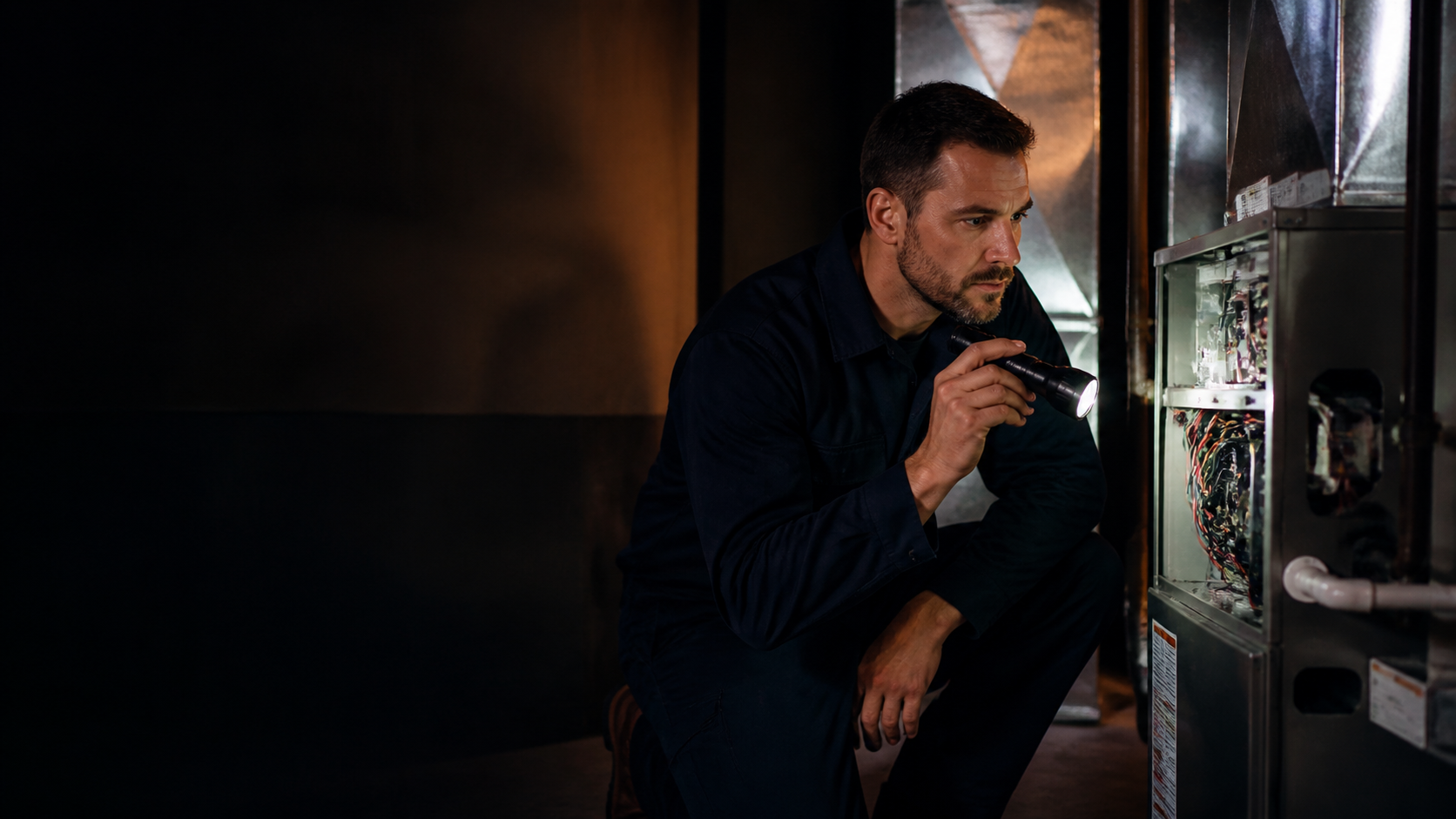
Who to call when the furnace stops
| What you notice | First call or action |
|---|---|
| Gas odor or a carbon monoxide alarm | Leave immediately and call 911 or the gas utility from outside |
| Smoke or a strong burning electrical smell | Leave if needed and call 911 from a safe location |
| Furnace is safe but will not start | Call us for a diagnosis |
| Furnace starts, stops, or blows cool air | Note the symptom, check the thermostat and filter, then call us for furnace repair |
| Thermostat is blank | Check its batteries if accessible; call us for a diagnosis if it stays blank |
Call emergency services or the gas utility first when there is danger
Don't treat every furnace problem as a repair appointment. If a carbon monoxide alarm sounds, get everyone outside into fresh air fast. Call 911 from outside, and don't go back in until responders give you permission. Don't try to find the source or restart the furnace. The Consumer Product Safety Commission's carbon monoxide guidance says don't operate an appliance involved in a carbon monoxide problem until trained personnel have serviced it.
If you smell natural gas or hear hissing, leave immediately. Don't stay inside to decide whether the odor's serious, and don't smoke, light a flame, touch electrical equipment, or try to find the leak. Washington Gas safety instructions recommend moving to a safe location before calling 911. After responders or the gas utility clear the situation, we can inspect the furnace. The order matters: emergency services and the gas utility handle immediate danger, while we handle a furnace that's safe to evaluate but not operating correctly.
- Leave for gas odor, a carbon monoxide alarm, smoke, or a situation that feels unsafe.
- Do not open the furnace cabinet or handle gas controls, wiring, combustion parts, or safety switches.
- Keep the furnace off until trained responders or we say it is safe to use.
Check these low-risk items before calling for furnace repair
If there's no gas odor, carbon monoxide alarm, smoke, or other obvious danger, you can make a few visible checks. Confirm the thermostat's set to heat, the set point's above room temperature, and the fan setting's what you expect. If its screen's blank and the thermostat uses batteries, check those batteries. Keep the furnace cabinet closed.
Look at the air filter if it's in an accessible homeowner location, and make sure supply registers and return grilles are open, not covered by furniture, rugs, or storage. A dirty filter or restricted airflow can make the furnace run longer and work harder, but a filter check isn't a furnace repair. ENERGY STAR's maintenance checklist places electrical connections, controls, the starting cycle, fuel connections, burner combustion, and the heat exchanger within professional maintenance work.
Note whether the furnace is silent, clicks without starting, starts and stops, or blows cool air. Look for an error code designed for homeowner viewing and take a photo rather than removing a panel. Simple checks not restoring heat? Stop troubleshooting and call us for a diagnosis.
- Do not bypass a safety switch or repeatedly reset a breaker that trips again.
- Do not remove a panel to reach a control board or probe electrical and combustion parts.
- Do not use a gas oven, electric oven, grill, or other cooking appliance as a room heater.
The normal call is us
For a furnace that's safe but not working, ask us for a furnace diagnosis. Use the words "furnace repair" or "no-heat diagnosis" when you call. You don't need to identify the igniter, flame sensor, pressure switch, control board, or another part first. One symptom can have several causes, and guessing the part can send the conversation in the wrong direction.
We can test furnace operation, controls, airflow, ignition, combustion, and related heating components. A thermostat issue, airflow restriction, ignition failure, control problem, or another component can all create a no-heat symptom. The fact that the system stopped doesn't, by itself, tell you the whole system needs replacement.
For non-emergency work, check our license and insurance, ask us for a written estimate, and review a written contract before work begins. The Federal Trade Commission's home repair guidance also warns against pressure to make an immediate decision. In Maryland, confirm any licensing or registration details that apply to the work.
- Call the gas utility instead of an HVAC company when you suspect a utility gas leak.
- Call 911 for an active gas emergency, a carbon monoxide alarm, smoke, or an unsafe situation.
- Ask us for the cause, the repair price, and whether repair makes sense before discussing replacement.
Tell us what changed
A useful call starts with the symptom, not a guessed part name. Write down what the furnace is doing, when the problem began, whether it happened suddenly, and whether the thermostat's set to heat. Note which rooms are cold, whether airflow feels normal, and any visible filter condition, error code, water, unusual odor, or sound you observed without opening the equipment.
A short description might sound like this: "The thermostat's set to heat, the furnace starts for about a minute, then shuts off. The filter's clean, the thermostat display's working, and there's no gas odor or carbon monoxide alarm." That gives us a useful starting point without pretending to diagnose the failure over the phone.
Don't remove the furnace door, jumper thermostat wires, or repeatedly reset a tripped safety device. The CPSC's furnace and carbon monoxide precautions advise against servicing fuel-burning appliances without the right knowledge, skill, and tools.
- Describe whether the furnace is not starting, blowing cool air, or starting and stopping.
- Mention the thermostat setting, room temperature, affected rooms, and any recent power outage.
- Share the fuel type and equipment age if you know them, but do not delay service to find those details.
A stopped furnace does not automatically mean replacement
A furnace that stops working needs a diagnosis before you decide whether to repair or replace it. A single repair on a system that's otherwise been dependable may be a different decision from repeated failures on old equipment. Replacement may deserve a closer look once the equipment's old, a major component or safety issue is involved, failures keep coming back, or the system can't solve ongoing comfort problems.
Start with what failed and what the system needs now. The practical next step is simple: if there's a gas odor or carbon monoxide alarm, leave and call 911 or the gas utility first. If the home's safe, check the thermostat and accessible filter, note what changed, and call us for a furnace diagnosis in Frederick County.
- Repair and replacement are separate decisions.
- Age, safety, major components, and repeated failures change the math.
- You should leave the service conversation knowing what failed and what needs attention now.
Questions that come up next
Who Do I Call If My Furnace Stops Working?
Call us once the home's safe but the furnace won't operate correctly. First check the thermostat and accessible filter without opening the cabinet. A gas odor, smoke, or carbon monoxide alarm means leave the home and call 911 or the gas utility from outside.
Should I reset my furnace breaker?
You can check it once if there's no burning smell or visible damage, but don't keep resetting a breaker that trips again. Leave it off and call us for a diagnosis.
What should I tell the furnace repair technician?
Tell us what the furnace's doing, when it started, what the thermostat shows, which rooms are affected, and any sound, odor, water, filter condition, or error code you observed without opening the equipment.
Can I use my oven to warm the house?
No. Don't use a gas or electric oven, grill, or cooking appliance as a heater. It can create a fire or carbon monoxide danger. Use safe supplemental heat as directed while you call us for service.
Need HVAC help in Frederick?
Tell us what the system is doing and what you've checked already. If it needs a visit, we'll say so.