Static pressure check
what it means for HVAC airflow
If a room stays warm while the HVAC system runs, the vents feel weak, or the ductwork whistles, you may hear a technician mention a static pressure check. The phrase sounds technical, but the idea is practical: the check looks at how hard the blower has to push air through the filter, coil, ducts, and other parts of the air path.
Static pressure is resistance to airflow inside a ducted HVAC system. CFM, or cubic feet per minute, describes how much air the system moves. High resistance can shrink the airflow that reaches your rooms, but a pressure reading doesn't identify one failed part by itself. The test has to be interpreted alongside the equipment model, fan setting, filter condition, duct layout, and the symptoms you noticed.
For a Frederick County homeowner, that distinction matters. Weak airflow can come from a filter, a return problem, a duct restriction, a coil, a blower, a damper, or a control issue. A useful static pressure check narrows the problem so you can discuss the next step with better information.
Start with the symptom
Note which rooms feel different, whether the system runs longer, and whether you hear whistling or unusual duct noise. Weak airflow won't convict one part on its own — but it tells us where to point the gauge.
Safe first checks
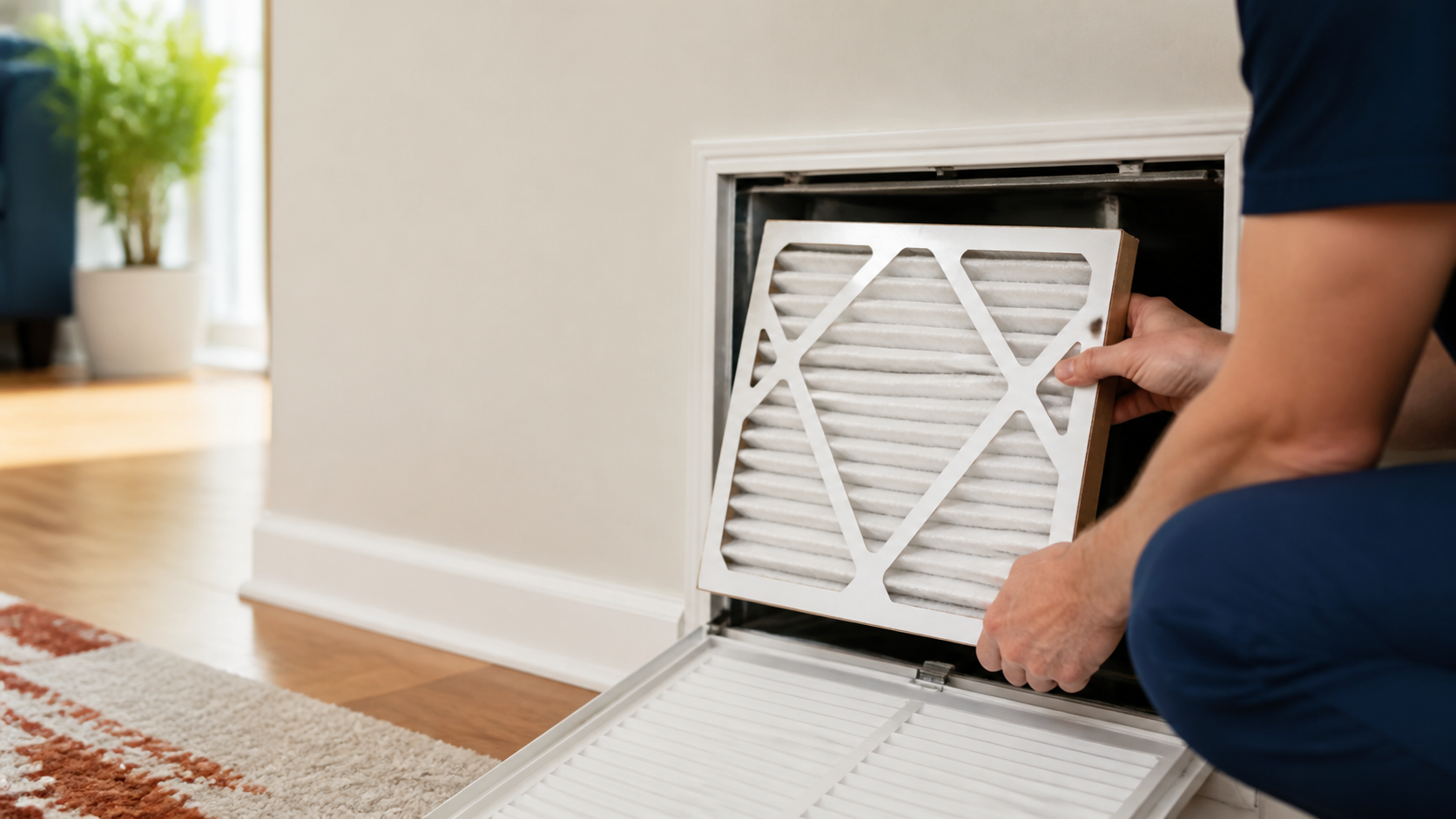
Look at the filter's size, condition, arrow direction, and fit. Make sure return grilles and supply vents are open and clear of furniture, rugs, and stored items.
What the reading means
A manometer reading is useful only with the equipment model, fan setting, filter, coil, duct layout, and symptoms. It points the diagnosis; it does not name a repair on its own.
What an HVAC static pressure check measures
A technician uses a manometer, a digital instrument that reads small pressure differences. The test uses appropriate points around the air handler or duct system rather than a hand placed over a register.
Depending on the equipment, the readings may be taken before and after the blower or at other manufacturer-specified locations.
The purpose is to determine total external static pressure and relate it to the blower's expected airflow. Pressure readings should be interpreted with the equipment manufacturer's fan tables.
Fan speed and fan condition are factors to verify during the process. A reading without that context is only a number.
It is not automatically proof that the ductwork, filter, blower, or coil needs replacement.
There is no single static pressure number that works as a pass or fail line for every home. Equipment design, fan speed, filter arrangement, coil, duct system, and the manufacturer's data all matter.
That is why a proper check includes both the measurement and the interpretation.
- The manometer measures small pressure differences at appropriate test locations.
- Total external static pressure is related to the blower's expected airflow.
- The equipment model, fan setting, filter, coil, and duct layout provide the needed context.
- A reading is not, by itself, proof that one part needs replacement.
Signs your system may have an airflow problem
Static pressure is not something most homeowners can feel directly. You notice its possible effects instead.
One room may stay warmer or cooler even though the thermostat says the system is running, or air from some registers may feel much weaker than air from others.
The ducts may whistle, rush, or sound unusually loud when the blower starts. The system may run for a long time without bringing the house to the set temperature.
Rooms can feel humid during cooling, or a filter may pull inward, bow, load with dust quickly, or sit incorrectly in its slot.
Those clues are useful, but they overlap. A weak vent doesn't tell you whether the issue is a clogged filter, dirty coil, crushed duct, closed damper, blower problem, or something else — which is why the first real step is pairing the symptom with a measurement and an inspection.
- One room stays warm or cool while the HVAC system runs.
- Some registers feel much weaker than others.
- Ducts whistle or become unusually loud when the blower starts.
- The system runs longer, rooms feel humid, or the filter bows or loads with dust quickly.
How a technician performs the check
The exact procedure depends on the equipment, but the reasoning usually follows the same path. First, the technician identifies the equipment and operating condition.
The fan speed, filter position, coil arrangement, and available test locations matter.
Next, the technician connects a manometer and uses probes or test ports at the correct supply and return locations. The measurement areas depend on the equipment manual and the system design.
The readings are then compared with the blower or equipment data.
A high total reading says that the air path has more resistance than the system should be asked to overcome at that operating condition. Separate pressure-drop checks can help show whether the filter or coil is contributing.
The technician may also inspect the blower, verify the fan setting, and look at the return and supply paths. The repair decision comes after that interpretation.
- Identify the equipment, fan speed, filter position, and operating condition.
- Measure at the correct supply and return locations with a manometer.
- Compare the result with the blower or equipment data.
- Inspect the filter, coil, blower, return, and supply paths before recommending a repair.
Common causes of high static pressure or restricted airflow
The filter is a reasonable place to begin, but it is not the whole diagnosis. A dirty filter adds resistance as it loads.
The filter type and fit matter too. A thicker or higher-efficiency filter is not automatically better for every existing system, and a filter that does not seal correctly can allow air to bypass the media.
The return side may be too small, blocked, poorly connected, or restricted by a closed grille or nearby storage. Supply ducts can be undersized, sharply bent, crushed, disconnected, or leaking.
Duct insulation gaps can also point to problems in unconditioned spaces. The whole duct system, including attic and crawlspace sections, may need evaluation.
The coil, blower wheel, dampers, and fan setting can change the result as well. A dirty coil can restrict air movement.
A blower that is dirty or not operating at the expected speed may not deliver the airflow the equipment data assumes. A closed damper may explain one branch of the house while the main system pressure remains within its expected range.
- A dirty, overly restrictive, incorrectly fitted, or poorly sealed filter.
- A blocked, undersized, or poorly connected return path.
- Undersized, sharply bent, crushed, disconnected, leaking, or poorly insulated ducts.
- A dirty coil or blower wheel, closed damper, or incorrect fan setting.
What you can check safely first
You can prepare useful information without opening the equipment cabinet. Check the thermostat mode, set point, fan setting, and batteries if the display is blank.
Look at the filter's size, condition, arrow direction, and fit. Make sure return grilles and supply vents are open and not blocked by furniture, rugs, or stored items.
Note which rooms feel different and whether the problem occurs in heating, cooling, or both. Write down new sounds, longer runtimes, dust around a grille, water, ice, unusual odors, or a breaker that trips.
A photo of the filter slot or a note about when the symptom started can help. Tell the technician what the system is doing instead of naming a part you have not tested.
Stop before removing panels or touching wiring, refrigerant lines, gas components, combustion parts, safety switches, or a blower wheel. Do not drill test holes into the equipment yourself.
A static pressure check is a measurement task that requires the right location, instrument, and interpretation.
- Check the thermostat settings and batteries if the display is blank.
- Inspect the filter's size, condition, arrow direction, and fit.
- Keep return grilles and supply vents open and clear.
- Do not remove panels, touch wiring or gas components, or drill test holes yourself.
When to schedule airflow diagnosis in Frederick County
Schedule an airflow or static pressure diagnosis when weak airflow, uneven rooms, loud ducts, long runtimes, or humidity keeps returning after the safe basics are checked. Ask what was measured, where it was measured, what equipment data was used, and what condition the result points to.
You should be able to understand why the recommendation is a filter change, duct repair, maintenance visit, equipment repair, or a different test.
Maintenance makes sense when the equipment is operating normally but needs its seasonal checks. Diagnosis makes more sense when a symptom has changed or keeps coming back.
Duct evaluation belongs in the conversation when the pressure test and comfort pattern point to the return or supply path — and once duct work is done, airflow should be re-measured to confirm it worked.
There is one safety issue that is separate from ordinary airflow diagnosis. Carbon monoxide can come from fuel-burning appliances.
If a CO alarm sounds, leave the home, call emergency services from outside, and do not go back in until responders say it is safe. Do not restart a furnace to see whether the alarm clears.
- Schedule a diagnosis when airflow or comfort problems keep returning after safe checks.
- Ask where the reading was taken and what equipment data was used.
- Use the result to separate a filter change, maintenance visit, equipment repair, or duct evaluation.
- If a carbon monoxide alarm sounds, leave and call emergency services from outside.
Write the symptom down before the gauge comes out
Which rooms miss out, how long the system runs, whether the ducts whistle when the blower wakes up — that's the human half of a static pressure diagnosis. The measurement gives the number; your notes give it something to mean.
Keep those notes with the system's file. A reading taken a year from now means far more next to a record of what the house felt like today.
- Rooms, runtimes, and sounds: the notes that turn a number into an answer.
The five-minute airflow once-over
Filter: right size, right direction, sitting square in its slot. Returns and supplies: open, unburied, breathing.
That's the entire safe homeowner checklist — and it clears the field so that whatever a pressure test finds later is real, not a rug parked on a grille.
Date the checklist when you finish it. If airflow still lags after it, that's the cue for the manometer, not another lap around the vents.
- Filter and grilles checked, dated, and left clear: then the measurement means something.
Answers to the usual follow-up questions
What is a good static pressure reading?
Every system has a design range it was built to handle, and a healthy reading falls within it. A number well above that range means a restriction is straining the system. Your technician compares the reading to your equipment's rating rather than to a single fixed target.
Can I check static pressure myself?
No, that one needs a technician. It takes a gauge and small test ports in the ducts. You can rule out the easy causes first, though: replace a dirty filter, clear blocked returns, and open closed vents.
Does a thicker filter cause high static pressure?
It can. A dense, high-MERV filter the system was not sized for can restrict airflow and raise pressure. The fix is matching the filter to the system, not simply buying the most restrictive one.
Why do my upstairs rooms stay hot in summer?
High static pressure and restricted airflow are one possible reason. When the system strains against a restriction, far and upstairs rooms can come up short. A pressure check helps confirm whether the cause is airflow or something else.
Why do my upstairs rooms stay hot in summer?Can high static pressure damage my system?
Yes, over time. It can overwork the blower motor and contribute to frozen coils in summer or furnace overheating in winter. Catching it during a tune-up and fixing the cause helps protect the equipment and manage run times.
Will a maintenance plan include a static pressure check?
A thorough plan may include a static pressure reading as part of the airflow check and use it to find restrictions early. It cannot rebuild undersized ducts on its own, but it can name the problem clearly so you can decide what to do with better information.
Will a maintenance plan include a static pressure check?