HVAC Filter Schedule for Pets, Allergies, and Frederick Dust
The honest answer to how often you should change your filter is: it depends, measurably. Pets, pollen, remodeling dust, heavy run time, and the filter itself all set the pace, and your house sets its own.
The method that works everywhere: inspect once a month, replace according to the filter or equipment instructions, and treat 60 to 90 days as a reference point rather than a rule. A gray, matted filter is the calendar speaking. It outranks any date on the package.
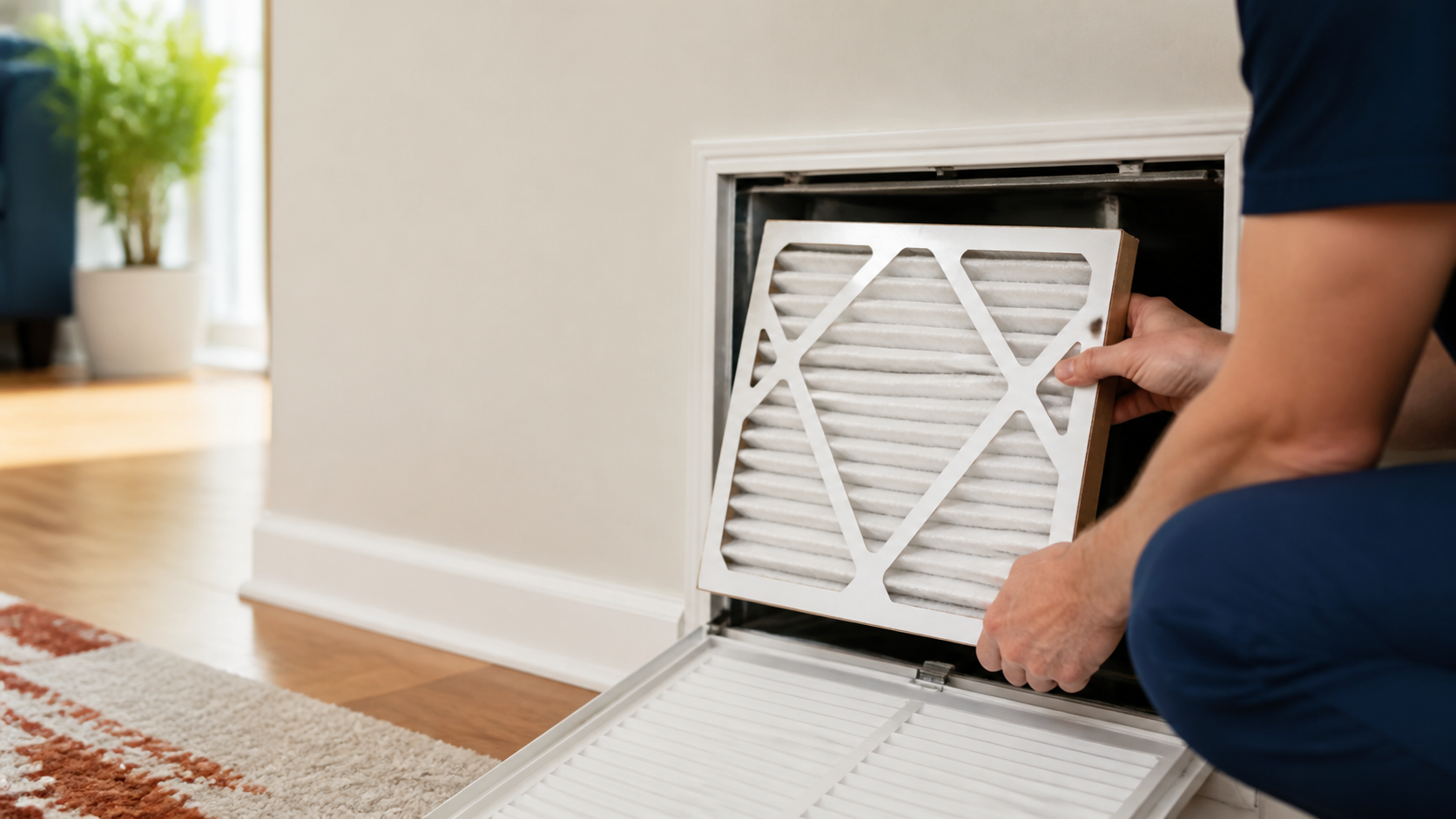
Check monthly
Turn the system off at the thermostat, inspect the filter, and record the size, rating, and change date. A monthly check teaches you how fast your home loads a filter.
Replace when loaded
Follow the instructions on the filter, equipment label, or owner's manual, but do not wait for a calendar date when the filter is gray, matted, or visibly packed with dust.
Stop if access is unsafe
Do not open electrical or fuel-burning equipment to reach a filter. Gas odor, smoke, sparking, a burning smell, a CO alarm, water, or ice calls for a stop and professional help.
What schedule should Frederick homeowners follow?
Check the filter once a month. That habit alone answers most of the scheduling question, because you watch your own dust accumulate instead of guessing at averages.
Follow the interval printed on the filter or in the equipment instructions when it gives one.
Use 60 to 90 days as a reference point, not a promise. County homes vary widely in dust load, pets, and run time.
And replace a visibly loaded filter sooner than any of it. The media does not know what day it is.
- Check the filter once a month.
- Follow the interval printed on the filter or equipment instructions.
- Use 60 to 90 days as a reference point, not a promise.
- Replace a visibly loaded filter sooner.
What should you check each month?
Turn the system off at the thermostat first. Moving air and a loose filter slot make a small job annoying.
Find the filter wherever it lives: the return grille, the air handler, the furnace, or wherever the manual says.
Match the size, and check the media for gray, matted, wet, bent, or damaged material.
Install the new one with the airflow arrow pointing toward the system, sitting flat, not crushed, with no large gap around the frame. Record the date, and note any change in airflow or operation afterward.
Six lines a month builds a real record.
- Turn the system off at the thermostat.
- Find the filter at the return grille, air handler, furnace, or manual-listed location.
- Match the size and check for gray, matted, wet, bent, or damaged media.
- Install the new filter with the airflow arrow pointing toward the system.
- Make sure it fits flat without crushing or leaving a large gap.
- Record the date and note any change in airflow or operation.
Do pets, allergies, or dust mean a shorter schedule?
They usually mean more inspection, and often more replacement.
Pets, pollen, heavy use, and dusty conditions load a filter faster than the box assumes.
Change a visibly dirty filter even when the calendar disagrees. The calendar is a suggestion; the media is the measurement.
A higher-rated filter helps only when the system can accommodate it. Restriction that chokes airflow trades one problem for another.
And treat moisture, musty air, and mold concerns as problems beyond the filter. No filter dries a house.
- Inspect more often when pets, pollen, heavy use, or dust load the filter quickly.
- Change a visibly dirty filter even when the calendar interval has not arrived.
- Use a higher-rated filter only when the system can accommodate it.
- Treat moisture, musty air, and mold concerns as problems beyond the filter.
What size and MERV rating should you use?
Match the dimensions and the rating listed for your equipment. The label is the requirement, not the starting bid.
A higher MERV rating is useful only when the system can move air through it. Otherwise you have bought restriction at a premium.
Never force, bend, or crush a filter to make it fit, and never leave a large gap around the frame. Air goes around what it cannot go through.
If airflow or comfort worsens after a filter change, arrange a diagnosis rather than experimenting with ratings.
- Match the dimensions and rating listed for your equipment.
- A higher MERV rating is useful only when the system can accommodate it.
- Never force, bend, crush, or leave a large gap around a filter.
- Arrange a diagnosis if airflow or comfort worsens after a filter change.
How do you know the filter is not the only problem?
When a correct, fresh filter does not fix it, the filter has been eliminated and the problem has not. Weak airflow or uneven comfort after a correct change is the classic signal.
Short cycling, repeated starts, or unusually long run times point past the filter at controls, refrigerant, or sizing.
Ice on the equipment or the lines, and water around the indoor unit, pan, or floor, are their own chapters.
Excess dust, humidity, or musty air that never improves deserves a diagnosis rather than another trip to the filter aisle.
- Weak airflow or uneven comfort after a correct filter change.
- Short cycling, repeated starts, or unusually long run times.
- Ice on the equipment or refrigerant lines.
- Water around the indoor unit, drain pan, or nearby floor.
- Excess dust, humidity, or musty air that does not improve.
Safety stops for filter work
Leave the home and call 911 from a safe location for a carbon-monoxide alarm or suspected CO exposure. That rule has no exceptions.
Stop for gas odor, smoke, fire, sparking, or a burning electrical smell. Filters can wait through all of it.
Do not continue after a breaker repeatedly trips, and do not open equipment or work on gas, electrical, or refrigerant components to reach a filter. No filter is worth any of those risks.
- Leave the home and call 911 from a safe location for a CO alarm or suspected CO.
- Stop for gas odor, smoke, fire, sparking, or a burning electrical smell.
- Do not continue after a breaker repeatedly trips.
- Do not open equipment or work on gas, electrical, or refrigerant components.
The next step for a filter question
Keep the monthly record going: size, rating, change date. Patterns in that record are diagnostic gold.
Bring unusually fast loading or ongoing comfort symptoms to a diagnosis instead of guessing up the MERV ladder.
Use maintenance for healthy equipment, and immediate safety help for dangerous conditions. The filter schedule sits between them, quietly doing its job.
- Keep a monthly filter record with the size, rating, and change date.
- Bring unusually fast loading or ongoing comfort symptoms to a diagnosis.
- Use maintenance for healthy equipment and immediate safety help for dangerous conditions.
The habit that answers the question
Once a month, off at the thermostat, look and log. The record tells you your interval within two or three cycles.
Write the date on the filter frame with a marker when you install it. Future-you will thank present-you.
- Monthly look, monthly log.
Answers to the usual follow-up questions
How often should I change my HVAC filter in Frederick?
Inspect monthly and replace per the filter or equipment instructions, with 60 to 90 days as a common reference. Pets, allergies, dust, and heavy use shorten the interval, and a visibly loaded filter overrides everything.
Do pets, allergies, or dust always mean monthly filter changes?
Not necessarily monthly replacement, but usually monthly inspection. Homes with shedding pets or allergy sufferers often land on a shorter interval, and your own monthly checks will show the pace faster than any chart.
What MERV filter is best for allergies?
The best MERV is the highest rating your equipment can handle without restricting airflow, matched to the listed size. Confirm compatibility before upgrading, because a restrictive filter on an unprepared system creates new problems.
Can a dirty filter cause HVAC problems?
Yes. A dirty filter restricts airflow, which can lengthen run times, strain components, encourage ice, and in some systems trip safety shutdowns. It is the cheapest HVAC problem to prevent.
What should I do if the filter is hard to reach?
If access requires opening electrical or fuel-burning equipment, stop and let a professional handle it during a regular visit. Filters behind panels are service items, not puzzles.
When should I stop and leave the home?
Leave immediately and call 911 from a safe location for a CO alarm or suspected exposure, and stop and seek help for gas odor, smoke, fire, or sparking. Filter maintenance resumes when the house is safe.