Boiler vs. Furnace: Which Is Better for a Frederick Home?
For most Frederick homeowners, the better choice is the system that fits the home already in front of you. A boiler usually makes sense when the house has working radiators, baseboards, or radiant floor tubing. A furnace is often the practical fit when the home already has usable ductwork, since that same duct network can serve heating and central cooling together.
That doesn't make every boiler the better comfort choice, or every furnace the better value. Equipment condition, fuel, insulation, layout, repair history, and the installation plan all matter. If your current system is failing, start with a diagnosis before turning a service call into a full conversion project.
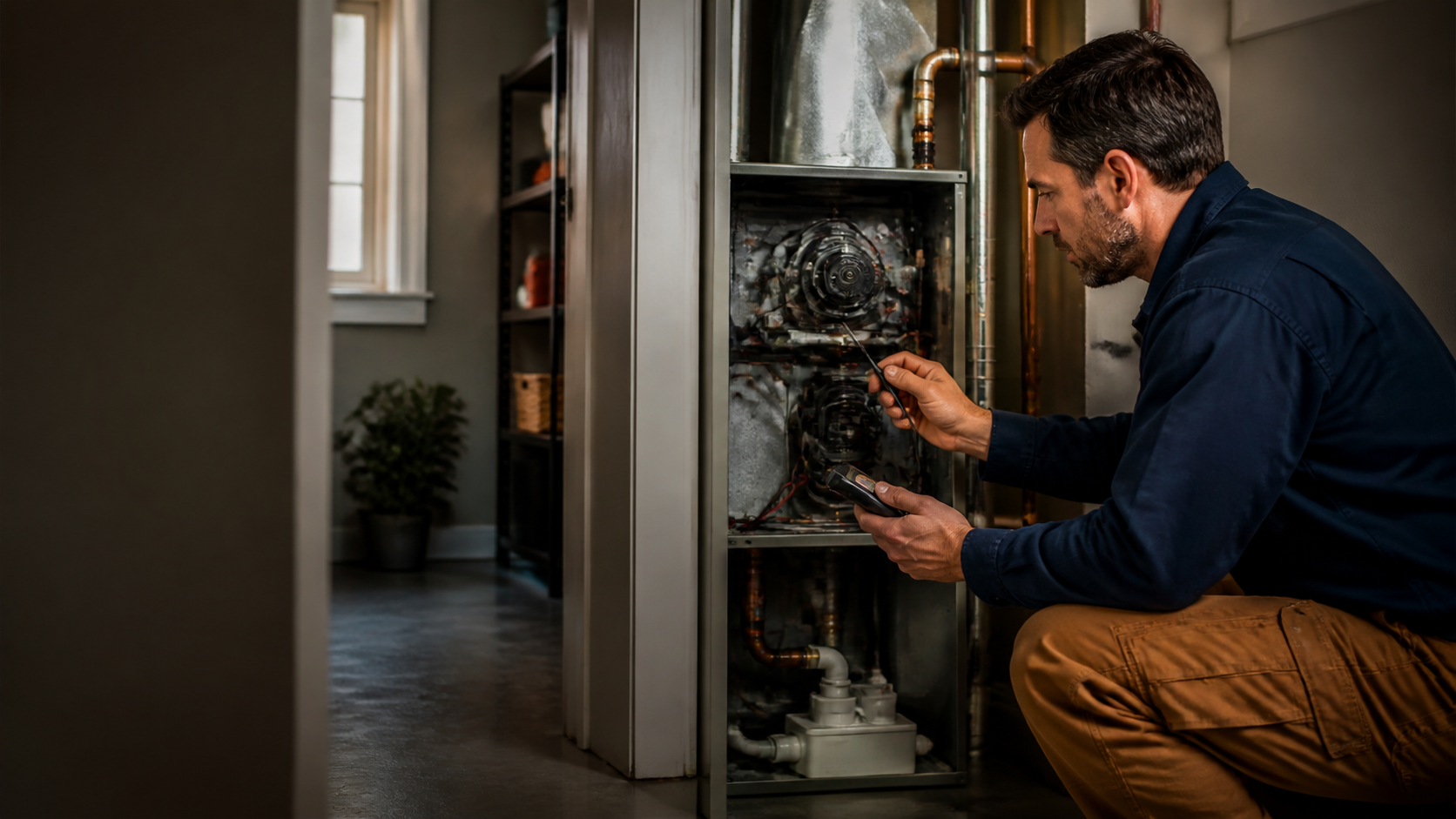
Boiler and furnace differences that matter at home
| Factor | Boiler | Furnace |
|---|---|---|
| Heat delivery | Hot water or steam through radiators/baseboards | Warm air through supply and return ducts |
| Air movement | Little forced-air movement from the heat source | Blower operation is central to comfort |
| Cooling compatibility | Usually needs a separate distribution solution for central cooling | Can share ductwork with central AC when the system fits |
| Efficiency context | AFUE is only part of the result; sizing and distribution matter | AFUE, blower, duct condition, and installation all affect the result |
| Common concern | Leaks, pressure, or a radiator that won't heat | Airflow, ignition, or a duct problem |
| Replacement questions | Piping, pumps, controls, vents, and drainage | Duct condition, sizing, venting, and return-air capacity |
How a boiler differs from a furnace
A boiler heats water or produces steam, then sends that heat through radiators, baseboard convectors, or radiant floor tubing. Its heat can feel steady and quiet, but a cold room may point to a valve, air, circulation, balance, insulation, or control problem rather than a failed boiler. Start with boiler service in Frederick that checks the heat source and the water or steam path together.
A furnace heats air and uses a blower to move it through supply and return ducts. A dirty filter, closed return, weak blower, disconnected duct, or sizing problem can leave rooms cold even while the burner is running. When we do a furnace repair, we trace the comfort problem through airflow, ignition, safety controls, venting, and heat transfer.
There are combinations, too. A boiler can heat a coil in an air handler, and a furnace can share ductwork with central air conditioning. The equipment label doesn't tell the whole comfort story. The distribution system does. A condensing furnace rated above 90 percent AFUE still runs cold rooms if the ducts feeding them are leaking or blocked.
- For a boiler, note which radiators or baseboards are cold, along with leaks or pressure changes.
- For a furnace, note whether airflow is weak everywhere or only in certain rooms, and how long each cycle lasts.
- Keep registers, baseboards, and radiators clear of furniture, carpeting, and drapes.
When a boiler or furnace fits better
A boiler may fit a Frederick home better when its radiators, baseboards, or radiant floor loops are in reasonable condition. Keeping the hot-water system can avoid running a large duct network through finished spaces. It still needs an inspection of the boiler and its pumps, the controls and expansion tank, and the relief valve, which is typically set near 30 psi.
A furnace is often the simpler path when the home already has ductwork that's accessible, sized, sealed, and capable of returning enough air. One duct network can serve heating and, with the right equipment, central cooling. Usable is the key word: leaks, missing insulation, disconnected sections, and restricted returns can create hot and cold rooms even when the furnace runs fine.
For either system, sizing matters. A quote should account for the home's calculated heating load, distribution condition, fuel, access, venting, controls, and how cooling, filtration, and humidity will work after the project. The ductwork service and HVAC maintenance routes can help separate a distribution problem from an equipment problem.
- Keep the existing hot-water system in play when the piping and radiators remain serviceable.
- Inspect ducts, return airflow, insulation, and room balance before assuming a furnace is the comfort solution.
- Ask how the home will handle central cooling if the proposed system changes the distribution path.
Compare efficiency, repair, and replacement together
AFUE is useful for comparing heating equipment, but it's not a promise about one Frederick home's utility bill. Distribution losses, heat loss, controls, maintenance, fuel, and installation all affect the result. Compare the full system rather than treating a boiler and furnace rating as interchangeable.
The boiler-versus-furnace question is sometimes a replacement question wearing a disguise. A noisy, short-cycling, weak, or ineffective system may have one failed component, a control problem, a blocked vent, restricted airflow, or a distribution issue. Repair is worth discussing when the equipment is safe, the problem is identifiable, and the rest of the system is sound.
Replacement deserves a closer look when a boiler or furnace is more than 15 years old, repairs are frequent, bills are rising, or comfort problems persist. Those are reasons to investigate, not an automatic command to replace. We'll tell you what we tested and why we recommend the work.
- Ask whether the heating load was calculated instead of copied from the old equipment size.
- Get safety, venting, access, distribution, controls, and drainage work spelled out in writing.
- Use a repair quote when one failed component is the real problem; compare replacement when condition and access make repair a poor fit.
Know the fuel-burning safety stop rules
Gas and oil boilers and furnaces need proper combustion, venting, and inspection. Treat carbon monoxide, flue-gas, smoke, or fuel odor as a safety concern first. If a CO alarm sounds, move everyone outside, call emergency services, and don't reenter until responders give permission.
Don't restart a fuel-burning appliance or open the equipment when you smell gas, see signs of unsafe venting, or suspect carbon monoxide. For a normal comfort problem with no safety warning, the next step is a diagnosis of the equipment and the home's distribution system.
Write down what changed before we arrive: whether the system starts, which rooms are affected, unusual sounds or smells, water near the equipment, pressure changes, thermostat messages, and recent repairs. A clear symptom description gives us a better starting point than a guessed part name.
- Leave the home for gas odor, smoke, fire, sparking, or a carbon monoxide alarm.
- Call 911 or the gas utility from a safe location when a safety warning is present.
- Don't keep resetting a breaker or attempt service on gas controls, venting, or live wiring.
Questions that come up next
Boiler vs. Furnace: Which Is Better for a Frederick Home?
It comes down to your distribution system, your comfort problem, and whether cooling's part of the plan. Boilers use water or steam and radiators; furnaces use heated air and ducts.
Can a boiler also cool my house?
A boiler can't move cooled air through its radiators. Central cooling usually needs ductwork or a separate ductless approach, so the full heating-and-cooling plan matters before you change systems.
Is a furnace cheaper to maintain than a boiler?
There's no universal answer. Each system has different service points, access conditions, and failure modes. We compare the actual equipment condition and maintenance needs rather than assuming one system costs less.
Need HVAC help in Frederick?
Tell us what the system is doing and what you've checked already. If it needs a visit, we'll say so.