Thermostat Says Cooling But No Cold Air
What the Technician Confirms
Your thermostat reads COOL, but the vents push room-temperature air. The setpoint is low, the screen looks fine, and yet nothing cold arrives on a hot Frederick afternoon.
That gap is the clue. The thermostat is only a request. It asks for cooling, but a chain of parts has to answer. When the screen says cool and the air does not, the break is somewhere between the request and the response.
Here is what that gap usually means. You will learn the safe checks that rule out the simple causes, and what the technician confirms before anyone swaps a part.
Check first
Set the thermostat to COOL, a few degrees below room temperature, with the fan on AUTO. Replace the battery if the screen looks odd. Check the filter and make sure the outdoor unit is running.
Stop here
Leave low-voltage wiring, the C-wire, the transformer, the control board, and any float switch to a tech. Do not reset a breaker that keeps tripping. Do not open electrical panels chasing the signal.
What to tell us
What the thermostat reads. Whether the outdoor unit runs. Any ice or water. Whether the air is warm or just not cold. When the gap started. That gap between the reading and the room is the whole diagnosis.
The short answer first
A thermostat does not cool anything. It reads the room temperature and, when the room is too warm, sends a low-voltage signal asking the system to cool.
The screen reading COOL means it wants to ask. It does not prove the request reached the equipment or that the equipment acted on it.
So a thermostat that says cooling while warm air comes out is telling you the chain broke after the request. Either the signal is not getting through, the outdoor unit is not running, the coil is not cooling, or a safety switch shut part of the system down.
The clues narrow it down. Does the outdoor unit hum?
Is the air warm or just not cold? Is there ice or water?
The most useful thing a service visit can do is confirm whether the cooling signal even reaches the equipment, before touching a part.
- The thermostat asks for cooling. It does not make it.
- A COOL reading does not prove the equipment got the signal.
- The break is somewhere between the request and the response.
- Confirming the cooling signal is the first real step.
Start with the settings and battery
Start at the thermostat, because the simplest causes hide there. Set it to COOL, not OFF or HEAT, with the setpoint a few degrees below the room.
If the setpoint is not actually below room temperature, the system has no reason to cool, even though the screen looks fine.
Check the fan and the battery. With the fan on ON instead of AUTO, the blower runs all the time and pushes warm air between cooling cycles.
That feels like the AC is failing when it is just moving warm air. A blank, dim, or frozen screen can mean a dead battery.
Replace it and see if the system kicks back on.
If the settings and battery are right and the house still will not cool, stop adjusting the thermostat. The next layer is what the thermostat is actually sending and whether the equipment gets it.
We measure that, not guess it, and that's where we start the visit.
- Set the mode to COOL with the setpoint below the room.
- Switch the fan from ON to AUTO so it stops pushing warm air.
- Replace the battery if the screen is blank, dim, or frozen.
- Stop adjusting once you've confirmed the settings and battery are right.
The C-wire and signal you cannot test yourself
A thermostat can look perfect and still have a wiring problem the screen never shows. Modern thermostats need steady low-voltage power, usually through a C-wire.
A loose, miswired, or missing C-wire can let the display work while the cooling signal never reaches the equipment. The thermostat says cool.
The system never hears it.
Heat pumps and staged systems add another layer. A thermostat set up wrong for the equipment can call for the wrong mode or stage cooling wrong, so the screen and the actual behavior disagree.
These are wiring and setup problems, not settings you change from the menu.
Low-voltage wiring, the C-wire, and the transformer are a tech's job. They are easy to misread without test tools.
A service visit can check the signal at the thermostat and at the equipment to confirm whether the request is leaving the wall and arriving where it needs to.
- A bad or missing C-wire can break cooling while the screen works.
- Wrong heat-pump or staging setup makes screen and behavior disagree.
- These are wiring and setup issues, not menu settings.
- A tech tests the signal at the thermostat and the equipment.
Is the outdoor unit actually running?
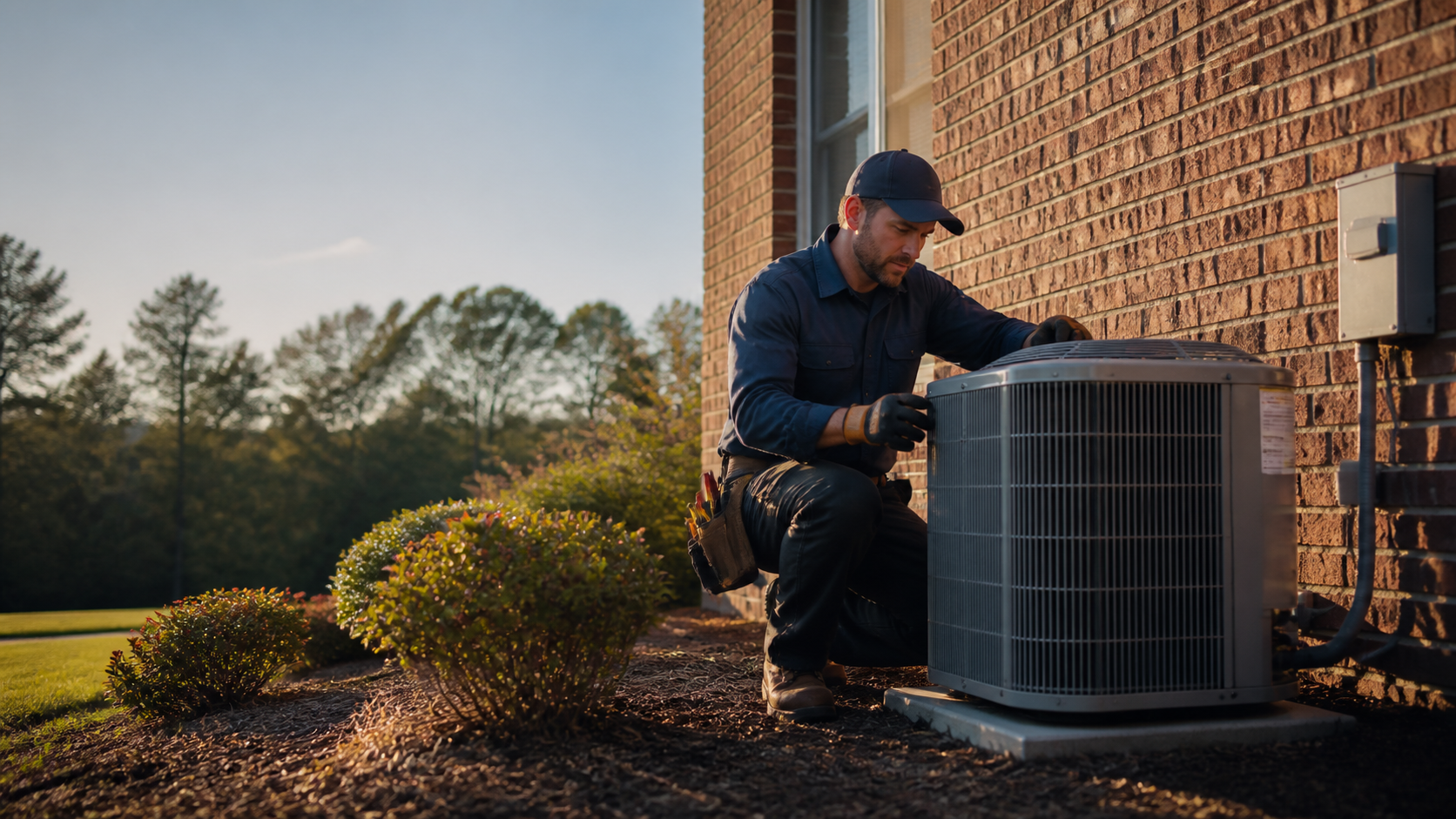
Walk outside to the outdoor unit while the thermostat is calling for cooling. A working unit hums and its fan spins.
If it sits silent, the fan will not turn, or you hear a hum with no spinning, the system cannot dump heat. The vents will blow warm air no matter what the thermostat reads.
A silent outdoor unit with a cooling call active is a strong clue. It can mean a failed capacitor, a weak contactor, or a tripped disconnect.
It could also be a struggling compressor, or a signal that never arrived. They all look the same from the patio, which is why we measure instead of guessing.
Check the breaker. If it tripped, reset it once and watch.
If it trips again, stop. Repeated trips point to an electrical fault, and that needs a tech.
Noting whether the outdoor unit runs and whether a breaker tripped gives the visit a head start.
- Confirm the outdoor fan spins while the thermostat is asking for cooling.
- A silent outdoor unit with an active call is a strong clue.
- Reset a tripped breaker once. Stop if it trips again.
- A humming unit with a still fan usually needs a capacitor test.
A frozen coil can block the cold air
Sometimes the system answers the thermostat's call and still cannot deliver cold air, because the coil iced over. When airflow drops from a clogged filter, or refrigerant runs low, the indoor coil can freeze into a block of ice.
That ice blocks the air so completely that the vents blow room-temperature air over a frozen coil.
This is where a dirty filter, closed vents, or a blocked return turns a healthy cooling call into no cold air. The thermostat is doing its job.
The equipment is trying. The blocked airflow chokes the result.
Ice on the copper line outside is a visible sign.
The safe move is to turn cooling off and leave the indoor fan running to thaw the coil. Check the filter and vents while you wait.
Do not chip the ice or keep forcing cooling on a frozen coil. That risks the compressor.
If ice comes back after the next cycle, the service visit should test airflow and refrigerant.
- A frozen coil blocks airflow even when the cooling call is fine.
- Dirty filters, closed vents, or low refrigerant can ice the coil.
- Turn cooling off and run the fan to thaw. Do not chip the ice.
- Ice coming back after a thaw means a charge and airflow test.
Refrigerant and parts you cannot reach
When the thermostat is right, the outdoor unit runs, and airflow is clear but the air still is not cold, the cause is usually in the sealed and electrical parts. Low refrigerant from a leak cuts the system's ability to pull heat out, so the air comes out barely cool or warm even with everything else working.
A failed capacitor is another common cause. It can leave the compressor or outdoor fan unable to start, so heat is never dumped and the indoor air never chills, even with a perfect cooling call.
These faults feel identical from inside the house, which is exactly why measurement matters.
Refrigerant and electrical parts are off-limits for homeowners. Refrigerant stays sealed inside the system by design, and capacitors hold a charge.
We check the refrigerant, test the capacitor and contactor, and read the temperature of the air across the coil to prove whether the system is really removing heat.
- Low refrigerant leaves the air barely cool even with a good call.
- A failed capacitor can stop the compressor or outdoor fan.
- These faults look identical from inside the house.
- Refrigerant and electrical parts are tech-only, measured not guessed.
Safety switches can shut the system off
A system can refuse the thermostat's call on purpose. Many ACs have a float switch on the drain that cuts cooling when the drain pan fills, to protect your home from water damage.
When it trips, the thermostat still reads COOL but the system will not cool. That is by design, not a failure.
That is why standing water near the air handler is worth noticing when the air will not get cold. A clogged drain that fills the pan can quietly shut the cooling call down.
The only outward sign is no cold air plus a thermostat that insists it is trying.
These switches exist to prevent damage, so never bypass them. A service visit clears the drain, checks the pan and pump, and confirms the float switch works.
That restores cooling by fixing the reason it shut off, not by defeating the protection that stopped it.
- A tripped float switch stops cooling while the thermostat still reads COOL.
- A clogged drain and full pan are a common, quiet cause.
- Standing water near the air handler is a clue worth noting.
- Never bypass a float switch. Clear the drain instead.
What we confirm during the service visit
This is the heart of the repair. A good visit confirms the cooling signal before it confirms anything else.
Expect the tech to check that the thermostat is actually sending the signal, that the equipment receives it, and to rule the wiring in or out before reaching for a part.
From there, the measurements tell apart look-alike causes. Expect a refrigerant check, a capacitor and contactor test, a look at the float switch and drain, and a reading of the air temperature across the coil to prove the system removes heat.
A thermostat fault, a wiring break, a stopped outdoor unit, and low refrigerant each need a different fix.
Ask what the tech measured and what the numbers showed before approving parts. If the talk jumps from a thermostat-or-capacitor question straight to replacing the system, slow down and ask why.
You deserve to hear which test pointed to the recommendation, in plain words, especially when the only symptom was a screen that disagreed with the room.
- Expect the cooling signal verified at the thermostat and equipment.
- Expect a refrigerant check, capacitor and contactor tests, and a drain check.
- Ask for the air temperature across the coil as proof of cooling.
- Ask which test result points to the repair.
What to do while you wait
Once you decide to call, stop forcing the system. Setting the thermostat far below the room does not make cooling arrive faster.
Running an AC that blows warm air for hours can deepen a coil freeze and stress the compressor. Turn cooling off if the coil has ice on it or the air stays warm.
Keep the house livable with simple steps in the Frederick heat. Close the blinds on the sunny side.
Run ceiling fans to move air. Hold off on the oven and dryer until the sun drops.
These do not answer the thermostat's call, but they buy comfort until the visit.
Leave the controls and equipment alone. Do not open the thermostat to rewire it.
Do not reset a breaker over and over. Do not bypass a float switch.
Keep the area around both units clear, and do not open panels for a part number. An undisturbed system is faster to diagnose.
- Do not crank the setpoint lower or run warm air for hours.
- Close blinds, run ceiling fans, and skip the oven and dryer midday.
- Do not rewire the thermostat, reset breakers repeatedly, or bypass switches.
- Keep the area around both units clear for the visit.
What to tell us when you call
Describe the gap plainly before guessing at a part. Saying "the thermostat reads COOL at 68, the room is 80, the outdoor unit is silent, and the vents blow room-temperature air" hands us most of the diagnosis in one sentence.
That beats "my thermostat is broken" every time.
The reading-versus-room gap and the outdoor unit's behavior are what actually change the diagnosis. What the thermostat reads versus the room.
Whether the outdoor unit runs. Whether the air is warm or just not cold.
Any ice or standing water. When the gap started.
If it began after a thermostat change, a storm, or a power blip, say so, because those events confuse controls and trip breakers.
If anything feels unsafe, lead with that. A burning smell, a breaker that keeps tripping, water spreading near the air handler, a gas smell, or a CO alarm comes first.
Safety details change how fast we need to get there.
- Lead with the gap: what the thermostat reads versus the room.
- Say whether the outdoor unit runs and the air is warm or just not cold.
- Note any ice, standing water, and when the gap started.
- State safety concerns first.
Answers to the usual follow-up questions
Why does my thermostat say cooling but no cold air comes out?
The thermostat only asks for cooling. It does not make it. A COOL reading with warm vents means something isn't answering that request, whether a wiring or setting issue, a stopped outdoor unit, a frozen coil, low refrigerant, or a tripped safety switch. We confirm the signal reaches the equipment before replacing any part.
Could the thermostat itself be the problem even though the screen works?
Yes. A working display does not prove the cooling signal is getting through. A bad or missing C-wire, a wrong heat-pump setup, or a low-voltage fault can leave the screen normal while the signal never reaches the equipment. That is why a tech tests the signal directly.
Could the thermostat itself be the problem even though the screen works?Why is my AC blowing room-temperature air instead of cold?
If the call is reaching the equipment, room-temperature air often points to a frozen coil, low refrigerant, a failed capacitor, or a stopped outdoor unit. Check that the outdoor fan spins and the filter is clean. If it still will not cool, the cause is in the sealed or electrical parts and needs a tech.
Why is my AC blowing room-temperature air instead of cold?Can a clogged drain stop cooling even when the thermostat is set right?
Yes. Many systems have a float switch that cuts cooling when the drain pan fills, to protect your home from water damage. The thermostat still reads COOL, but the system will not cool until you clear the drain. Never bypass the float switch. Have a tech service the drain instead.
Should I keep lowering the thermostat to force cold air?
No. A lower setpoint does not make cooling arrive faster, and running warm air for hours can deepen a coil freeze and stress the compressor. Turn cooling off if the air stays warm or the coil has ice on it, do the safe checks, and schedule service.
What details matter most when the thermostat says cooling but the air isn't cold?
Keep it plain. Tell us what the thermostat reads versus the room, whether the outdoor unit runs, whether the air is warm or just not cold, any ice or standing water, and when it started. That's enough for us to tell whether it's the signal, the outdoor unit, or the coil before we even show up.